Terminology for the descriptive sensory analysis of cachaça produced using cell recycling of commercial yeasts
DOI:
https://doi.org/10.58430/jib.v132i3.103Keywords:
cachaça, sensory, lexicon, quantitative descriptors, analysis, yeast, fermentation, recyclingAbstract
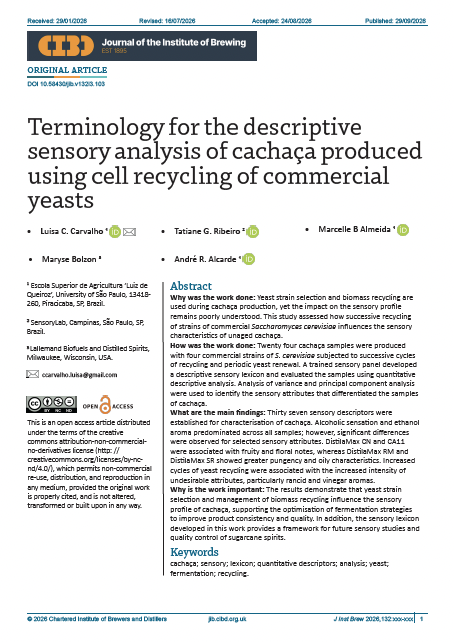
Why was the work done: Yeast strain selection and biomass recycling are used during cachaça production, yet the impact on the sensory profile remains poorly understood. This study assessed how successive recycling of strains of commercial Saccharomyces cerevisiae influences the sensory characteristics of unaged cachaça.
How was the work done: Twenty four cachaça samples were produced with four commercial strains of S. cerevisiae subjected to successive cycles of recycling and periodic yeast renewal. A trained sensory panel developed a descriptive sensory lexicon and evaluated the samples using quantitative descriptive analysis. Analysis of variance and principal component analysis were used to identify the sensory attributes that differentiated the samples of cachaça.
What are the main findings: Thirty seven sensory descriptors were established for characterisation of cachaça. Alcoholic sensation and ethanol aroma predominated across all samples; however, significant differences were observed for selected sensory attributes. DistilaMax CN and CA11 were associated with fruity and floral notes, whereas DistilaMax RM and DistilaMax SR showed greater pungency and oily characteristics. Increased cycles of yeast recycling were associated with the increased intensity of undesirable attributes, particularly rancid and vinegar aromas.
Why is the work important: The results demonstrate that yeast strain selection and management of biomass recycling influence the sensory profile of cachaça, supporting the optimisation of fermentation strategies to improve product consistency and quality. In addition, the sensory lexicon developed in this work provides a framework for future sensory studies and quality control of sugarcane spirits.
Downloads
References
Bortoletto AM. 2023. Rum and cachaça, p 61–74. In Hill A, Jack F (eds), Distilled Spirits. Elsevier, Amsterdam, The Netherlands.
Bortoletto AM, Correa AC, Alcarde AR. 2016. Aging practices influence chemical and sensory quality of cachaça. Food Res Int 86:46–53.
Bortoletto AM, Silvello GC, Alcarde AR. 2021. Aromatic profiling of flavor active compounds in sugarcane spirits aged in tropical wooden barrels. Braz J Food Technol 24:e20190711.
Carvalho L, Silvello G, Castro M, Bolzon M, Piggot R, Fossati E, Alcarde AR. 2025. Yeast recycling and the chemical and sensory quality of cachaça. J Inst Brew 131:41–54.
Corbion C, Smith-Ravin J, Marcelin O, Bouajila J. 2023. An overview of spirits made from sugarcane juice. Molecules 28:6810.
De Cássia F, Gomes O, Amália de Carvalho Araújo R, Cisalpino PS, Spangler E, Moreira A, Zani CL, Rosa CA. 2009. Comparison between two selected Saccharomyces cerevisiae strains as fermentation starters in the production of traditional cachaça. Arch Biol Technol 52:449–455.
De Souza MDCA, Vásquez P, Del Mastro NL, Acree TE, Lavin EH. 2006. Characterization of cachaça and rum aroma. J Agric Food Chem 54:485–488.
dos Santos Navarro RDC, Minim VPR, Simiqueli AA, da Silva Moraes LE, Gomide AI, Minim LA. 2012. Optimized descriptive profile: a rapid methodology for sensory description. Food Qual Prefer 24:190–200.
He Y, Tang K, Yu X, Chen S, Xu Y. 2022. Identification of compounds contributing to trigeminal pungency of baijiu by sensory evaluation, quantitative measurements, correlation analysis, and sensory verification testing. J Agric Food Chem 70:598–606.
Ickes CM, Cadwallader KR. 2017. Characterization of sensory differences in mixing and premium rums through the use of descriptive sensory analysis. J Food Sci 82:2679–2689.
International Organization for Standardization. 1977. ISO 3591:1977. Sensory analysis - Apparatus -Wine-tasting glass. ISO, Geneva, Switzerland.
Jack F. 2021. Sensory analysis, p 321–333. In Stewart GG, Kellershohn J, Russell I (eds), Whisky and Other Spirits: Technology, Production and Marketing. 3rd ed. Elsevier, Amsterdam, The Netherlands.
Laguna L, Bartolomé B, Moreno-Arribas MV. 2017. Mouthfeel perception of wine: oral physiology, components and instrumental characterization. Trends Food Sci Technol 59:49–59.
Marques C, Correia E, Dinis LT, Vilela A. 2022. An overview of sensory characterization techniques: from classical descriptive analysis to the emergence of novel profiling methods. Foods 11:225.
Oliveira ES, Rosa CA, Morgano MA, Serra GE. 2005. The production of volatile compounds by yeasts isolated from small Brazilian cachaça distilleries. World J Microbiol Biotechnol 21:1569–1576.
Ratkovich N, Esser C, de Resende Machado AM, Mendes BA, Cardoso MG. 2023. The spirit of cachaça production: an umbrella review of processes, flavor, contaminants and quality improvement. Foods 12:3325
Scriven LE, Sternling CV. 1960. The Marangoni effects. Nature 187:186-188.
Sinkinson C. 2017. Triangle test, p 153–170. In Rogers L (ed) Discrimination Testing in Sensory Science: A Practical Handbook.
Venerus DC, Nieto Simavilla D. 2015. Tears of wine: new insights on an old phenomenon. Sci Rep 5:16162.
Vilela A. 2021. Sensory and volatile flavor analysis of beverages. Foods 10:177.
Vilela AF, Oliveira LSC, Muniz MB, Melo BCA, Figueiredo MJ, Vieira Neto JM. 2021. Assessment of sensory and physical-chemical quality, and potential for certification of cachaças from the state of Paraíba, Brazil. Food Sci Technol 41:661–668.
Vuilleumier R, Ego V, Neltner L, Cazabat AM. 1995. Tears of wine: the stationary state. Langmuir 11:4117–4121.
Williams EJ. 1949. Experimental designs balanced for the estimation of residual effects of treatments. Aust J Chem 2:149–168.
Downloads
Published
How to Cite
Issue
Section
License
Copyright (c) 2026 Journal of the Institute of Brewing

This work is licensed under a Creative Commons Attribution-NonCommercial-NoDerivatives 4.0 International License.
This is an open access article which permits non-commercial re-use, distribution, and reproduction in any medium, provided the original work is properly cited, and is not altered, transformed or built upon in any way.
Permission will be required if the proposed reuse is not covered by the terms of the License. In this event, email the Editor in Chief - david.quain@cibd.org.uk - with details of your request.