Yeast recycling and the chemical and sensory quality of cachaça
DOI:
https://doi.org/10.58430/jib.v131i1.67Keywords:
Saccharomyces cerevisiae, yeast recycling, distilled spirit, cachaça, rate all that apply, physicochemical characteristicsAbstract
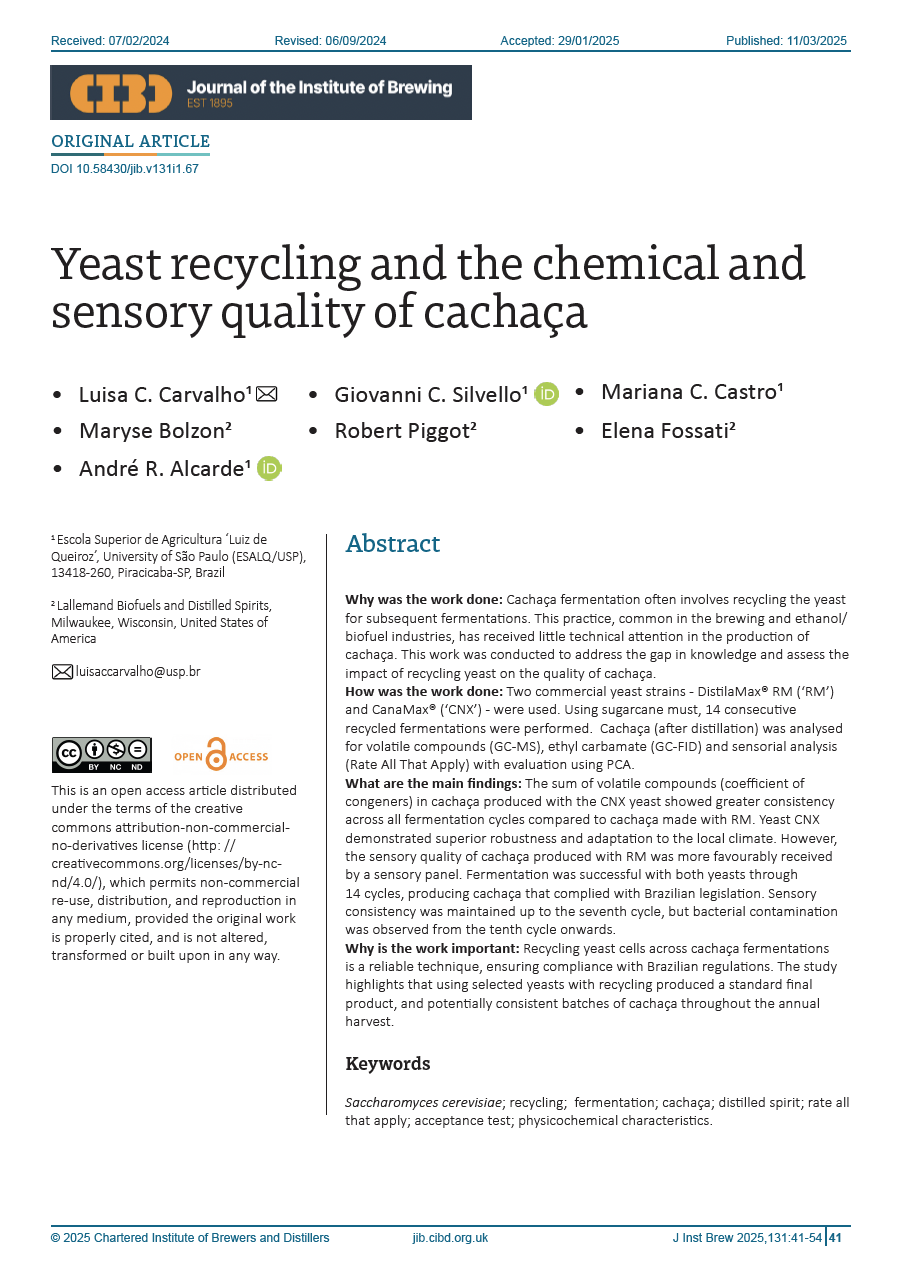
Why was the work done: Cachaça fermentation often involves recycling the yeast for subsequent fermentations. This practice, common in the brewing and ethanol/biofuel industries, has received little technical attention in the production of cachaça. This work was conducted to address the gap in knowledge and assess the impact of recycling yeast on the quality of cachaça.
How was the work done: Two commercial yeast strains - DistilaMax® RM (‘RM’) and CanaMax® (‘CNX’) - were used. Using sugarcane must, 14 consecutive recycled fermentations were performed. Cachaça (after distillation) was analysed for volatile compounds (GC-MS), ethyl carbamate (GC-FID) and sensorial analysis (Rate All That Apply) with evaluation using PCA.
What are the main findings: The sum of volatile compounds (coefficient of congeners) in cachaça produced with the CNX yeast showed greater consistency across all fermentation cycles compared to cachaça made with RM. Yeast CNX demonstrated superior robustness and adaptation to the local climate. However, the sensory quality of cachaça produced with RM was more favourably received by a sensory panel. Fermentation was successful with both yeasts through 14 cycles, producing cachaça that complied with Brazilian legislation. Sensory consistency was maintained up to the seventh cycle, but bacterial contamination was observed from the tenth cycle onwards.
Why is the work important: Recycling yeast cells across cachaça fermentations is a reliable technique, ensuring compliance with Brazilian regulations. The study highlights that using selected yeasts with recycling produced a standard final product, and potentially consistent batches of cachaça throughout the annual harvest
Downloads
References
Alcarde AR, De Souza LM, Bortoletto AM. 2012. Ethyl carbamate kinetics in double distillation of sugarcane spirit. J Inst Brew 118:27-31.
Amorim JC, Schwan RF, Duarte WF. 2016. Sugarcane spirit (cachaça): Effects of mixed inoculum of yeasts on the sensory and chemical characteristics. Food Res Int 85:76–83.
Àres G, Bruzzone F, Vidal L, Cadena RS, Giménez A, Pineau B, Hunter DC, Paisley AG, Jaeger SR.
Evaluation of a rating-based variant of check-all-that-apply questions: Rate-all-that-apply (RATA). Food Qual Prefer 36:87–95.
Badotti F, Belloch C, Rosa CA, Barrio E, Querol A. 2010. Physiological and molecular characterisation of Saccharomyces cerevisiae cachaça strains isolated from different geographic regions in Brazil. World J Microbiol Biotechnol 26:579–587.
Bernardi TL, Pereira GVM, Cardoso PG, Dias ES, Schwan RF. 2008. Saccharomyces cerevisiae strains associated with the production of cachaça: identification and characterization by traditional and molecular methods (PCR, PFGE and mtDNA-RFLP). World J Microbiol Biotechnol 24:2705–2712.
Bortoletto AM. 2023. Rum and cachaça, p 61-74. In Hill A, Jack F (eds), Distilled Spirits. Academic Press.
Bortoletto AM, Alcarde AR. 2013. Congeners in sugarcane spirits aged in casks of different woods. Food Chem 139:695–701.
Bortoletto AM, Silvello GC, Alcarde AR. 2015. Chemical and microbiological quality of sugarcane juice influences the concentration of ethyl carbamate and volatile congeners in cachaça. J Inst Brew 121:251–256.
Bortoletto AM, Silvello GC, Alcarde AR. 2018. Good manufacturing practices, hazard analysis and critical control point plan proposal for distilleries of cachaça. Sci Agric 75: 432-443.
Brazil. 2022. MAPA Ordinance No. 539/2022. Establishes the Identity and Quality Standards for sugarcane brandy and cachaça.
Caetano DL, Lima CM, Sanson AL, Silva DF, Hassemer GS, Verruck S, Silva GA, Afonso RJCF, Coutrim MX, Gregório SR. 2021. Descriptive screening and lexicon development of non-aged artisanal cachaça sensorial profile using principal component analysis and Kohonen artificial neural networks. J Sens Stud 36:12645.
Campos CR, Silva CF, Dias DR, Basso LC, Amorim HV, Schwan RF. 2010. Features of Saccharomyces cerevisiae as a culture starter for the production of the distilled sugarcane beverage, cachaça in Brazil. J Appl Microbiol 108:1871–1879.
Czerny M, Christlbauer M, Christlbauer M, Fischer A, Granvogl M, Hammer M, Hartl C, Hernandez NM, Schieberle P. 2008. Re-investigation on odour thresholds of key food aroma compounds and development of an aroma language based on odour qualities of defined aqueous odorant solutions. Eur Food Res Technol 228:265–273.
Dato MCF, Pizauro Júnior JM, Mutton MJR. 2005. Analysis of the secondary compounds produced by Saccharomyces cerevisiae and wild yeast strains during the production of ‘cachaça’. Braz J Microbiol 36:70–74.
Duarte WF, Dias DR, Oliveira JM, Vilanova M, Teixeira JÁ, Silva JBA, Schwan RF. 2010. Raspberry (Rubus idaeus L.) wine: Yeast selection, sensory evaluation and instrumental analysis of volatile and other compounds. Food Res Int 43:2303–2314.
Duarte WF, Sousa MVF, Dias DR, Schwan RF. 2011. Effect of co-inoculation of Saccharomyces cerevisiae and Lactobacillus fermentum on the quality of the distilled sugarcane beverage cachaça. J Food Sci 76:C1307–C1318.
Erten H, Tanguler H. 2010. Influence of Williopsis saturnus yeasts in combination with Saccharomyces cerevisiae on wine fermentation. Lett Appl Microbiol 50: 474–479.
Fleet GH, Heard GM. 1993. Yeast-growth during fermentation. In Fleet GH (ed), Wine Microbiology and Biotechnology, Harwood Academic Publishers, Chur, Switzerland.
Maia AB, Marinho LS, Nelson DL. 2020. Advance in the characterization of alambic cachaça: ethyl lactate. Res Soc Dev 9:e297997116.
Nascimento ESP, Cardoso DR, Franco DW. 2008. Quantitative ester analysis in cachaça and distilled spirits by gas chromatography-mass spectrometry (GC-MS). J Agric Food Chem 56:5488–5493.
Nonato E, Carazza F, Silva FC, Carvalho CR, Cardeal ZL. 2001. A headspace solid-phase microextraction method for the determination of some secondary compounds of Brazilian sugarcane spirits by gas chromatography. J Agric Food Chem 49:3533–3539.
Odello L, Braceschi GP, Seixas FRF, Silva AA, Galinaro CA, Franco DW. 2009. Sensory evaluation of cachaça. Quim Nova 32:1839–1844
Oliveira ACD, Oliveira CAF, Kamimura ES. 2023. Microbial contamination in the ethanol and cachaça fermentation process: impacts and applications. Food Sci Technol 43:1-8.
Oliveira VA, Vicente MA, Fietto LG, Castro IM, Coutrim MX, Schüller D, Alves H, Casal M, Santos JO, Araújo LD, Silva PHA, Brandão RL. 2008. Biochemical and molecular characterization of Saccharomyces cerevisiae strains obtained from sugarcane juice fermentations and their impact in cachaça production. Appl Environ Microbiol 74:693–701.
Portugal CB, Alcarde AR, Bortoletto AM, Silva AP. 2016. The role of spontaneous fermentation for the production of cachaça: a study of case. Eur Food Res Technol 242:1587-1597.
Portugal CB, Silva AP, Bortoletto AM, Alcarde AR. 2017. How native yeasts may influence the chemical profile of the Brazilian spirit, cachaça? Food Res Int 91:18–25.
Giacalone D, Hedelund PI. 2016. Rate-all-that-apply (RATA) with semi-trained assessors: An investigation of the method reproducibility at assessor-, attribute- and panel-level. Food Qual Prefer 51: 65–71.
Guerra JB, Araújo RA, Pataro C, Franco GR, Moreira ES, Mendonça-Hagler LC, Rosa CA. 2001. Genetic diversity of Saccharomyces cerevisiae strains during the 24 h fermentative cycle for the production of the artisanal Brazilian cachaça. Lett Appl Microbiol 33:106–111.
International Organization for Standardization. ISO 8589:2007. 2007. Sensory Analysis: General guidance for the design of test rooms. International Organization for Standardization: Geneva, Switzerland.
Jenkins CL, Kennedy AI, Hodgson JA, Thurston P, Smart KA. 2003. Impact of serial repitching on lager brewing yeast quality. J Am Soc Brew Chem 61:1–9.
Kalayu G. 2019. Serial re-pitching: its effect on yeast physiology, fermentation performance, and product quality. Ann Microbiol 69:787-796.
Lachenmeier DW, Sohnius EM. 2008. The role of acetaldehyde outside ethanol metabolism in the carcinogenicity of alcoholic beverages: Evidence from a large chemical survey. Food Chem Toxicol 46:2903–2911.
Lê S, Josse J, Husson F. 2008. FactoMineR: an R package for multivariate analysis. J Stat Softw 25:1-18.
Lopes ML, Paulillo SCL, Godoy A, Cherubin RA, Lorenzi MS, Giometti FHC, Bernardino CD, Amorim Neto HB, Amorim HV. 2016. Ethanol production in Brazil: a bridge between science and industry. Braz J Microbiol 47:64–76.
Serafim FAT, Seixas FRF, Silva AA, Galinaro CA, Nascimento ESP, Buchviser SF, Odello L, Franco DW. 2013. Correlation between chemical composition and sensory properties of Brazilian sugarcane spirits (Cachaças). J Braz Chem Soc 24:973–982.
Souza MDCA, Vásquez P, Del Mastro NL, Acree TE, Lavin EH. 2006. Characterization of cachaça and rum aroma. J Agric Food Chem 54:485–488.
Vidal EE, Billerbeck GM, Simões DA, Schuler A, François JM, Morais Junior MA. 2013. Influence of nitrogen supply on the production of higher alcohols/esters and expression of flavour-related genes in cachaça fermentation. Food Chem 138:701–708.
Williams EJ. 1949. Experimental designs for the estimation of residual effects of treatments. Aust J Agric Res 2:149-168.
Downloads
Published
Versions
- 05-05-2025 (3)
- 01-05-2025 (2)
- 11-03-2025 (1)
How to Cite
Issue
Section
License
Copyright (c) 2025 Journal of the Institute of Brewing

This work is licensed under a Creative Commons Attribution-NonCommercial-NoDerivatives 4.0 International License.
This is an open access article which permits non-commercial re-use, distribution, and reproduction in any medium, provided the original work is properly cited, and is not altered, transformed or built upon in any way.
Permission will be required if the proposed reuse is not covered by the terms of the License. In this event, email the Editor in Chief - david.quain@cibd.org.uk - with details of your request.