Quantifying the impact of increasing wash strength for Scotch malt whisky production: a modelling study
DOI:
https://doi.org/10.58430/jib.v132i2.97Keywords:
malt whisky, wash, high gravity fermentation, energy saving, water saving, cost saving, sustainabilityAbstract
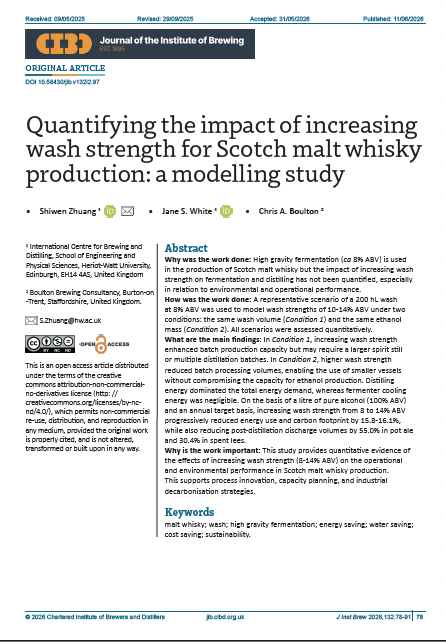
Why was the work done: High gravity fermentation (ca 8% ABV) is used in the production of Scotch malt whisky but the impact of increasing wash strength on fermentation and distilling has not been quantified, especially in relation to environmental and operational performance.
How was the work done: A representative scenario of a 200 hL wash at 8% ABV was used to model wash strengths of 10-14% ABV under two conditions: the same wash volume (Condition 1) and the same ethanol mass (Condition 2). All scenarios were assessed quantitatively.
What are the main findings: In Condition 1, increasing wash strength enhanced batch production capacity but may require a larger spirit still or multiple distillation batches. In Condition 2, higher wash strength reduced batch processing volumes, enabling the use of smaller vessels without compromising the capacity for ethanol production. Distilling energy dominated the total energy demand, whereas fermenter cooling energy was negligible. On the basis of a litre of pure alcohol (100% ABV) and an annual target basis, increasing wash strength from 8 to 14% ABV progressively reduced energy use and carbon footprint by 15.8-16.1%, while also reducing post-distillation discharge volumes by 55.0% in pot ale and 30.4% in spent lees.
Why is the work important: This study provides quantitative evidence of the effects of increasing wash strength (8-14% ABV) on the operational and environmental performance in Scotch malt whisky production. This supports process innovation, capacity planning, and industrial decarbonisation strategies.
Downloads
References
Aylott RI, MacKenzie WM. 2010. Analytical strategies to confirm the generic authenticity of Scotch whisky. J Inst Brew 116:215–229.
Buxton I, Hughes PS. 2021. Crop-to-cask – production of new make spirit, p 99-142. The Science and Commerce of Whisky, 2nd ed. The Royal Society of Chemistry, London, UK.
Duffy C, Styles D, Schestak I, Macgregor K, Jack F, Henn D, Black K, Iannetta PPM (2023) Optimising sustainability: Circular pathways for Scotch Whisky distillery co-products. J Clean Prod 395:136436.
Edwards C, McNerney CC, Lawton LA, Palmer J, Macgregor K, Jack F, Cockburn P, Plummer A, Lovegrove A, Wood A. 2022. Recoverable resources from pot ale & spent wash from Scotch Whisky production. Resour Conserv Recycl 179:106114.
Gibson BR, Lawrence SJ, Leclaire JPR, Powell CD, Smart KA. 2007. Yeast responses to stresses associated with industrial brewery handling. FEMS Microbiol Rev 31:535–569.
Gibson B, Dahabieh M, Krogerus K, Jouhten P, Magalhães F, Pereira R, Siewers V, Vidgren V. 2020. Adaptive laboratory evolution of ale and lager yeasts for improved brewing efficiency and beer quality. Annu Rev Food Sci Technol 11:23-44.
Howard DA, Ma Z, Engvang JA, Hagenau M, Jørgensen KL, Olesen JF, Jørgensen BN. 2020. Optimization of energy flexibility in cooling process for brewery fermentation with multi-agent simulation. In The 6th IEEJ international workshop on Sensing, Actuation, Motion Control, and Optimization (SAMCON2020). Tokyo.
Kang X, Lin R, O’Shea R, Deng C, Li L, Sun Y, Murphy JD. 2020. A perspective on decarbonizing whiskey using renewable gaseous biofuel in a circular bioeconomy process. J Clean Prod 255:120211.
Kelsall RD, Lyons TP. 2003. Practical management of yeast: conversion of sugars to ethanol, pp 123–123. In Jacques KA, Lyons TP, Kelsall DR (eds) The Alcohol Textbook, 4th edn. Nottingham University Press, Nottingham, UK, .
Pothakos V, Debeer N, Debonne I, Rodriguez A, Starr JN, Anderson T. 1981. Fermentation titer optimization and impact on energy and water consumption during downstream processing. Chem Eng Technol 41:2358-2365.
Puligundla P, Smogrovicova D, Mok C, Obulam VSR. 2020. Recent developments in high gravity beer-brewing. Innov Food Sci Emerg Technol 64:102399.
Richardson JF, Harker JH, Backhurst JR. 2002. Coulson and Richardson’s Chemical Engineering (Particle Technology and Separation Processes), 5th edn. Elsevier Science, Amsterdam, Netherlands
Smith JM, Van Ness HC, Abbott MM, Swihart MT. 2018. Introduction to chemical engineering thermodynamics. McGraw-Hill Education, Ohio, United States.
Stewart GG. 2010. High gravity brewing and distilling-past experiences and future prospects. J Am Soc Brew Chem 68:1-9.
Stewart K, Willoughby N, Zhuang S. 2024. Research trends on valorisation of agricultural waste discharged from production of distilled beverages and their implications for a “three-level valorisation system”. Sustainability (Switzerland) 16: 6847.
White JS, Stewart KL, Maskell DL, Diallo A, Traub-Modinger JE, Willoughby NA. 2020. Characterization of pot ale from a Scottish malt whisky distillery and potential applications. ACS Omega 5:6429-6440.
Zhuang S, Smart K, Powell C. 2017. Impact of extracellular osmolality on Saccharomyces yeast populations during brewing fermentations. J Am Soc Brew Chem 75:244-254.
Zhuang S, Smart K, Powell CD. 2019. The relationship between wort sugar concentration and yeast carbon partitioning during brewing fermentations. J Am Soc Brew Chem 77:225-234.
Downloads
Published
Versions
- 22-07-2026 (3)
- 22-07-2026 (2)
- 11-06-2026 (1)
How to Cite
Issue
Section
License
Copyright (c) 2026 Journal of the Institute of Brewing

This work is licensed under a Creative Commons Attribution-NonCommercial-NoDerivatives 4.0 International License.
This is an open access article which permits non-commercial re-use, distribution, and reproduction in any medium, provided the original work is properly cited, and is not altered, transformed or built upon in any way.
Permission will be required if the proposed reuse is not covered by the terms of the License. In this event, email the Editor in Chief - david.quain@cibd.org.uk - with details of your request.