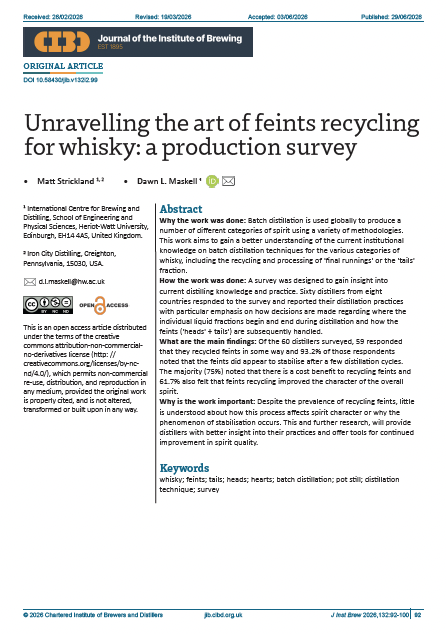
Unravelling the art of feints recycling for whisky: a production survey
DOI:
https://doi.org/10.58430/jib.v132i2.99Keywords:
whisky, feints, tails, heads, hearts, batch distillation, pot still, distillation techniqueAbstract
Why the work was done: Batch distillation is used globally to produce a number of different categories of spirit using a variety of methodologies. This work aims to gain a better understanding of the current institutional knowledge on batch distillation techniques for the various categories of whisky, including the recycling and processing of 'final runnings' or the 'tails' fraction.
How the work was done: A survey was designed to gain insight into current distilling knowledge and practice. Sixty distillers from eight countries respnded to the survey and reported their distillation practices with particular emphasis on how decisions are made regarding where the individual liquid fractions begin and end during distillation and how the feints ('heads' + tails') are subsequently handled.
What are the main findings: Of the 60 distillers surveyed, 59 responded that they recycled feints in some way and 93.2% of those respondents noted that the feints did appear to stabilise after a few distillation cycles. The majority (75%) noted that there is a cost benefit to recycling feints and 61.7% also felt that feints recycling improved the character of the overall spirit.
Why is the work important: Despite the prevalence of recycling feints, little is understood about how this process affects spirit character or why the phenomenon of stabilisation occurs. This and further research, will provide distillers with better insight into their practices and offer tools for continued improvement in spirit quality.
Downloads
References
Allen AH. 1897. The chemistry of whisky. J Inst Brew 3:24-48.
Buglass AJ, McKay M, Gook Lee C. 2011. Distilled Spirits, p 466-468. In Buglass AJ (ed), Handbook of Alcoholic Beverages. John Wiley, Chichester, UK.
Da Porto C, Natolino A, De Corti D. 2010. Batch distillation of grappa: effect of the recycling operation. Int J Food Sci Tech 45:271-277.
Douady A, Puentes C, Awad P, Esteban-Decloux M. 2019. Batch distillation of spirits: experimental study and simulation of the behaviour of volatile aroma compounds. J Inst Brew 125:268-283.
Esteban-Decloux M, Grangeon H, Romaric Tano N. 2023. Behaviour of volatile compounds during batch multi-stage distillation of whisky: experimental and simulation data. J Inst Brew 128:171-187.
Hastie S. 1925. The application of chemistry to pot still distillation. J Inst Brew 31:198-215.
Kelly T, O'Connor C, Kilcawley K. 2023. Sources of volatile aromatic congeners in whiskey. Beverages 64:1-28.
Monica Lee K, Paterson A, Piggott J, Richardson G. 2001. Origins of flavour in whiskies and a revised flavour wheel: a review. J Inst Brew 107:287-313.
Muller SB. 1992. The analytical composition of the feints fraction of Scotch malt whisky. MSc thesis, Heriot Watt University.
Nicol DA. 2022. Batch Distillation, p 247-270. In Russell I, Stewart GG, Kellershohn J (eds), Whisky and Other Spirits, Academic Press, London, UK.
Santos EJ. 2021. Real-time electronic measurement of alcohol content in distilled spirits production. IEEE Trans Instrum Meas 70:1-9.
Schidrowitz P, Kaye F. 1906. The distillation of whisky. J Inst Brew 12:496-517.
Strickland M. 2021. Batch Distillation: Science and Practice. White Mule Press, California, USA
Wolstenholme AG. 2023. Whisk(e)y, p 1-36. In Hill A, Jack F (eds), Distilled Spirits. Academic Press, London, UK.
Downloads
Published
Versions
- 22-07-2026 (2)
- 29-06-2026 (1)
How to Cite
Issue
Section
License
Copyright (c) 2026 Journal of the Institute of Brewing

This work is licensed under a Creative Commons Attribution-NonCommercial-NoDerivatives 4.0 International License.
This is an open access article which permits non-commercial re-use, distribution, and reproduction in any medium, provided the original work is properly cited, and is not altered, transformed or built upon in any way.
Permission will be required if the proposed reuse is not covered by the terms of the License. In this event, email the Editor in Chief - david.quain@cibd.org.uk - with details of your request.