Comparison of laboratory scale bourbon whiskey mashing and fermentation to pilot scale
DOI:
https://doi.org/10.58430/jib.v131i2.73Keywords:
bourbon, whiskey, small scale, mashing, fermentation, scale upAbstract
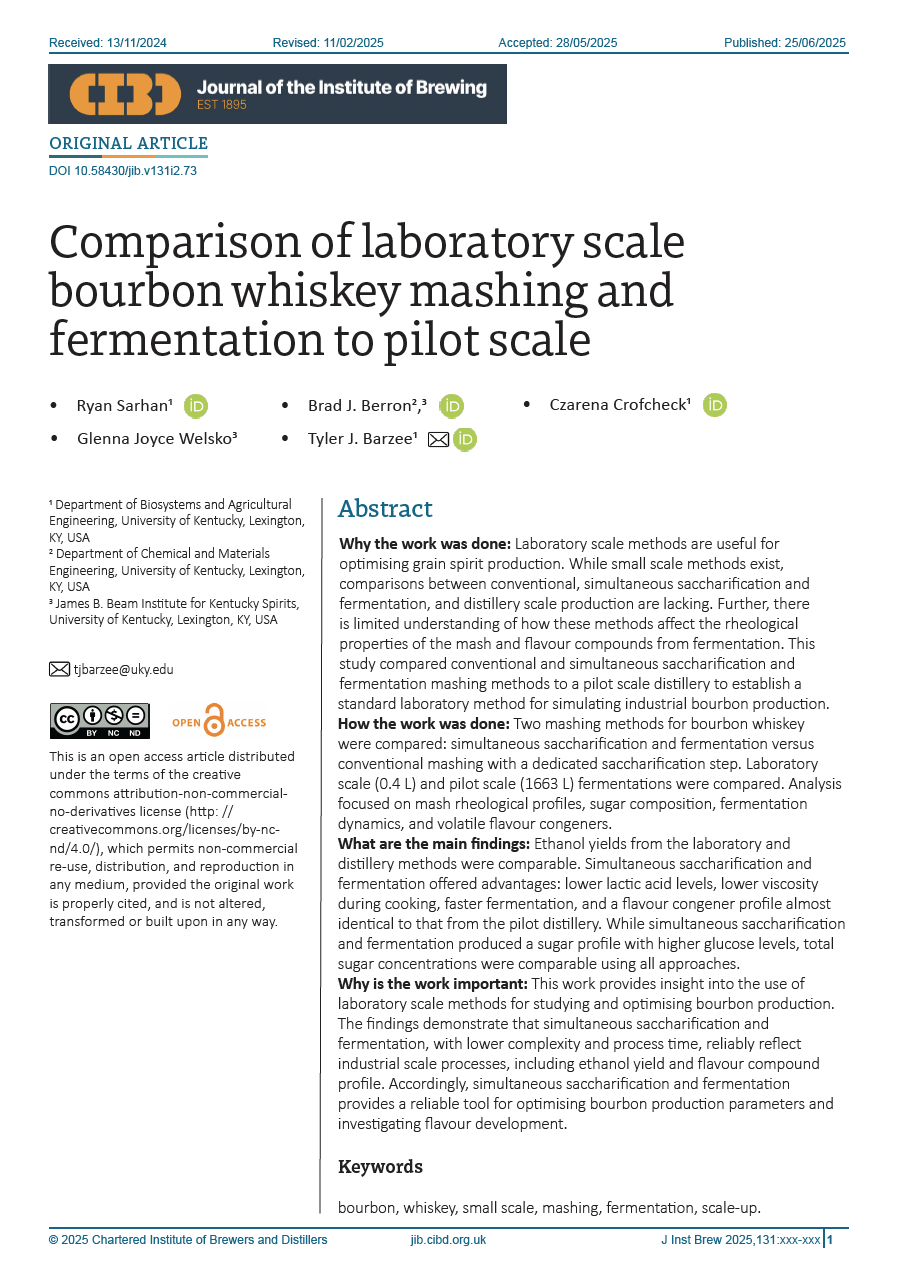
Why the work was done: Laboratory scale methods are useful for optimising grain spirit production. While small scale methods exist, comparisons between conventional, simultaneous saccharification and fermentation, and distillery scale production are lacking. Further, there is limited understanding of how these methods affect the rheological properties of the mash and flavour compounds from fermentation. This study compared conventional and simultaneous saccharification and fermentation mashing methods to a pilot scale distillery to establish a standard laboratory method for simulating industrial bourbon production.
How the work was done: Two bourbon whiskey mashing methods were compared: simultaneous saccharification and fermentation versus conventional mashing with a dedicated saccharification step. Laboratory scale (0.4 L) and pilot scale (1663 L) fermentations were compared. Analysis focused on mash rheological profiles, sugar composition, fermentation dynamics, and volatile flavour congeners.
What are the main findings: Ethanol yields from the laboratory and distillery methods were comparable. Simultaneous saccharification and fermentation offered advantages: lower lactic acid levels, lower viscosity during cooking, faster fermentation, and a flavour congener profile almost identical to that from the pilot distillery. While simultaneous saccharification and fermentation produced a sugar profile with higher glucose levels, total sugar concentrations were comparable using all approaches.
Why is the work important: This work provides insight into the use of laboratory scale methods for studying and optimising bourbon production. The findings demonstrate that simultaneous saccharification and fermentation, with lower complexity and process time, reliably reflect industrial scale processes, including ethanol yield and flavour compound profile. Accordingly, simultaneous saccharification and fermentation provides a reliable tool for optimising bourbon production parameters and investigating flavour development.
Downloads
References
Agu RC, Bringhurst TA, Brosnan JM. 2006. Production of grain whisky and ethanol from wheat, maize and other cereals. J Inst Brew 112:314-323.
Agu RC, Bringhurst TA, Brosnan JM. 2012. Effect of batch to batch variation on the quality of laboratory and commercially malted Oxbridge barley. J Inst Brew 118:49-56.
Agu RC, Bringhurst TA, Brosnan JM, Jack FR. 2008. Effect of process conditions on alcohol yield of wheat, maize and other cereals. J Inst Brew 114:39-44.
Agu RC, Nwanguma BC, Moneke AN, Okolo BN. 2014. Cereal flours and starches: potential implications when using a combination of cereal types for alcohol production. Tech Q Master Brew Assoc Am 51:89-96.
Agu RC, Palmer GH. 1999. Development of microorganisms during the malting of sorghum. J Inst Brew 105:101-106.
Agu RC, Swanston JS, Walker JW, Pearson SY, Bringhurst TA, Brosnan JM, Jack FR. 2009. Predicting alcohol yield from UK soft winter wheat for grain distilling: combined influence of hardness and nitrogen measurements. J Inst Brew 115:183-190.
Arnold RJ, Ochoa A, Kerth CR, Miller RK, Murray SC. 2019. Assessing the impact of corn variety and Texas terroir on flavor and alcohol yield in new make bourbon whiskey. PLoS ONE 14:8.
Ben Mariem S, Soba D, Zhou B, Loladze I, Morales F, Aranjuelo I. 2021. Climate change, crop yields, and grain quality of C3 cereals: a meta-analysis of [CO2], temperature, and drought effects. Plants (Basel) 10:1052.
Cason DT, Reid GC, Gatner EMS. 1987. On the differing rates of fructose and glucose utilisation in Saccharomyces cerevisiae. J Inst Brew 93:23-25.
Crosbie GB, Ross AS (eds). 2007. The RVA Handbook. AACC International, St. Paul, Minn.
Cruz MC. 2003. Tequila production from agave: historical influences and contemporary processes, p 229. In Jacques KA, Lyons TP, Kelsall DR (eds), The Alcohol Textbook: a Reference for the Beverage, Fuel and Industrial Alcohol Industries, 4th ed, Nottingham University Press, Nottingham.
Engan, S. 1972, Wort composition and beer flavour. II. The influence of different carbohydrates on the formation of some flavour components during fermentation. J Inst Brew. 78:169-173.
He Y, Dong J, Yin H, Zhao Y, Chen R, Wan X, Chen P, Hou X, Liu J, Chen L. 2014. Wort composition and its impact on the flavour active higher alcohol and ester formation of beer - a review. J Inst Brew 120:157-163.
Hockensmith D, Crofcheck C, Barzee TJ. 2024. Impacts of material characteristics on the anaerobic digestion kinetics and biomethane potential of American bourbon and whiskey stillage. J Environ Manage 367:121975.
Hohmann S. 2002. Osmotic stress signalling and osmoadaptation in yeasts. Microbiol Mol Biol Rev 66:300-372.
Ingledew WM, Thomas KC, Hynes SH, McLeod JG. 1999. Viscosity concerns with rye mashes used for ethanol production. Cereal Chem 76:459-464.
McCleary BV, McLoughlin C. 2021. Measurement of available carbohydrates in cereal and cereal products, dairy products, vegetables, fruit, and related food products and animal feeds: first action 2020.07. J AOAC Int 104:1465-1478.
O’Sullivan TF, Walsh Y, O’Mahony A, Fitzgerald GF, Sinderen D. 2012. A comparative study of malthouse and brewhouse microflora. J Inst Brew 105:55-61.
Okolo BN, Amadi OC, Moneke AN, Nwagu TN, Nnamchi CI. 2020. Influence of malted barley and exogenous enzymes on the glucose/maltose balance of worts with sorghum or barley as an adjunct. J Inst Brew 126:46–52.
Pielech-Przybylska K, Balcerek M, Nowak A, Wojtczak M, Czyżowska A, Dziekońska Kubczak U, Patelski P. 2017. The effect of different starch liberation and saccharification methods on the microbial contaminations of distillery mashes, fermentation efficiency, and spirits quality. Molecules 22:1647.
Schierbaum F, Kettlitz B. 1994. Studies on rye starch properties and modification. Part III: Viscograph pasting characteristics of rye starches. Starch 46:2-8.
Schüller C, Brewster JL, Alexander MR, Gustin MC, Ruis H. 1994. The HOG pathway controls osmotic regulation of transcription via the stress response element (STRE) of the Saccharomyces cerevisiae CTT1 gene. EMBO J 13:4382-4389.
Verges VL, Gollihue JW, Joyce GE, DeBolt S. 2023. Lab scale methodology for new make bourbon whiskey production. Foods 12:457.
Wang ZX, Zhuge J, Fang H, Prior BA. 2001. Glycerol production by microbial fermentation: a review. Biotechnol Adv 19:201-223.
Weiss T, Barretto R, Chen G, Hong S, Li Y, Zheng Y, Sun XS, Wang D. 2023. Blue, red and white maize as a sustainable resource for production of distilled spirit. J Agric Food Res 14:100770.
Wess J, Brinek M, Boles E. 2019. Improving isobutanol production with the yeast Saccharomyces cerevisiae by successively blocking competing metabolic pathways as well as ethanol and glycerol formation. Biotechnol Biofuels 12:173.
Wilson NR. 2022. Contamination: bacteria and wild yeasts in whisky fermentation, p 237. In Russell I, Stewart GG, Kellershohn J (eds), Whisky and Other Spirits, Academic Press.
Wright S, Pilkington H. 2022. Whiskies of Canada and the United States, p 87. In Russell I, Stewart GG, Kellershohn J (eds), Whisky and Other Spirits, Academic Press.
Younis OS, Stewart GG. 1998. Sugar uptake and subsequent ester and higher alcohol production by Saccharomyces cerevisiae. J Inst Brew 104:255-264.
Zhao R, Bean SR, Wang D, Park SH, Schober TJ, Wilson JD. 2009. Small scale mashing procedure for predicting ethanol yield of sorghum grain. J Cereal Sci 49:230-238.
Downloads
Published
Versions
- 21-07-2025 (2)
- 25-06-2025 (1)
How to Cite
Issue
Section
License
Copyright (c) 2025 Journal of the Institute of Brewing

This work is licensed under a Creative Commons Attribution-NonCommercial-NoDerivatives 4.0 International License.
This is an open access article which permits non-commercial re-use, distribution, and reproduction in any medium, provided the original work is properly cited, and is not altered, transformed or built upon in any way.
Permission will be required if the proposed reuse is not covered by the terms of the License. In this event, email the Editor in Chief - david.quain@cibd.org.uk - with details of your request.