Brazilian Mantiqueira hops: composition and potential industrial use
DOI:
https://doi.org/10.58430/jib.v131i1.69Keywords:
bittering compounds, alpha acids, beta acids, xanthohumol, pressurised fluid extraction, co-solventAbstract
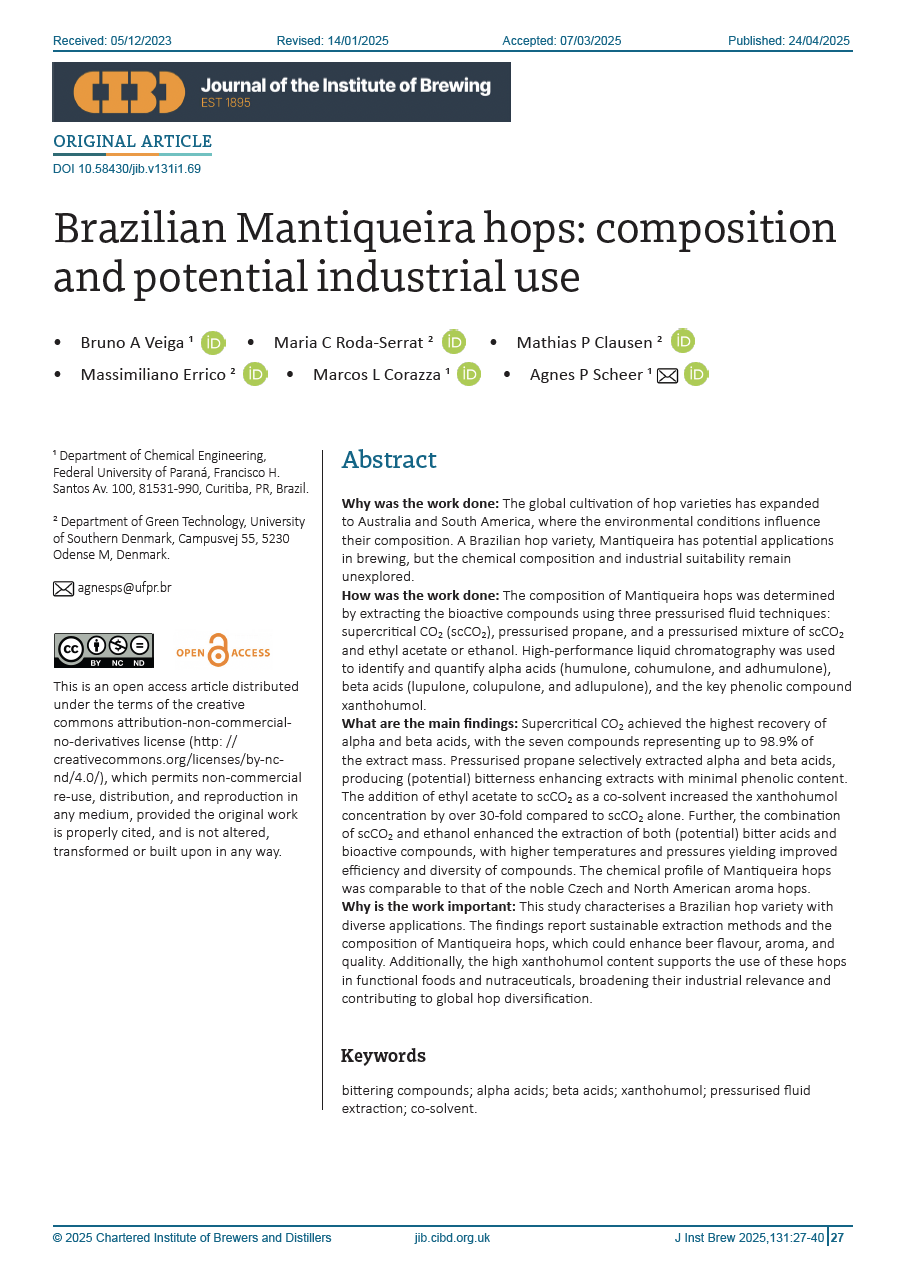
Why was the work done: The global cultivation of hop varieties has expanded to Australia and South America, where the environmental conditions influence their composition. A Brazilian hop variety, Mantiqueira has potential applications in brewing, but the chemical composition and industrial suitability remain unexplored.
How was the work done: The composition of Mantiqueira hops was determined by extracting the bioactive compounds using three pressurised fluid techniques: supercritical CO₂ (scCO₂), pressurised propane, and a pressurised mixture of scCO₂ and ethyl acetate or ethanol. High-performance liquid chromatography was used to identify and quantify alpha acids (humulone, cohumulone, and adhumulone), beta acids (lupulone, colupulone, and adlupulone), and the key phenolic compound xanthohumol.
What are the main findings: Supercritical CO₂ achieved the highest recovery of alpha and beta acids, with the seven compounds representing up to 98.9% of the extract mass. Pressurised propane selectively extracted alpha and beta acids, producing (potential) bitterness enhancing extracts with minimal phenolic content. The addition of ethyl acetate to scCO₂ as a co-solvent increased the xanthohumol concentration by over 30-fold compared to scCO₂ alone. Further, the combination of scCO₂ and ethanol enhanced the extraction of both (potential) bitter acids and bioactive compounds, with higher temperatures and pressures yielding improved efficiency and diversity of compounds. The chemical profile of Mantiqueira hops was comparable to that of the noble Czech and North American aroma hops.
Why is the work important: This study characterises a Brazilian hop variety with diverse applications. The findings report sustainable extraction methods and the composition of Mantiqueira hops, which could enhance beer flavour, aroma, and quality. Additionally, the high xanthohumol content supports the use of these hops in functional foods and nutraceuticals, broadening their industrial relevance and contributing to global hop diversification.
Downloads
References
Andrade TA. 2018. Energy-efficient conversion of castor oil for biodiesel production: Investigate novel energy-efficient biodiesel production technologies such as enzymes and membranes. University of Southern Denmark, Faculty of Engineering.
Arruda TR, Pinheiro PF, Silva PI, Bernardes PC. 2022. Exclusive raw material for beer production? Addressing greener extraction techniques, the relevance, and prospects of hops (Humulus lupulus L.) for the food industry. Food Bioproc Tech 15:275–305.
Bermejo DV, Ibáñez E, Reglero G, Fornari T. 2016. Effect of cosolvents (ethyl lactate, ethyl acetate and ethanol) on the supercritical CO2 extraction of caffeine from green tea. J Supercrit Fluids 107:507–512.
Bermejo DV, Mendiola JA, Ibáñez E, Reglero G, Fornari T. 2015. Pressurized liquid extraction of caffeine and catechins from green tea leaves using ethyl lactate, water and ethyl lactate + water mixtures. Food Bioprod Process 96:106–112.
Bessada SMF, Barreira JCM, Barros L, Ferreira ICFR, Oliveira MBPP. 2016. Phenolic profile and antioxidant activity of Coleostephus myconis (L.) Rchb.f.: An underexploited and highly disseminated species. Ind Crops Prod 89:45–51.
Bizaj K, Škerget M, Košir IJ, Knez Ž. 2021. Sub- and supercritical extraction of Slovenian hops (Humulus lupulus L.) Aurora variety using different solvents. Plants 10:1137.
Bizaj K, Škerget M, Košir IJ, Knez Ž. 2022. Hop (Humulus lupulus L.) Essential oils and xanthohumol derived from extraction process using solvents of different polarity. Horticulturae 8:368.
Bocquet L, Sahpaz S, Hilbert JL, Rambaud C, Rivière C. 2018. Humulus lupulus L. a very popular beer ingredient and medicinal plant: overview of its phytochemistry, its bioactivity, and its biotechnology. Phytochem Rev 17:1047–1090.
Bolton JL, Dunlap TL, Hajirahimkhan A, Mbachu O, Chen S-N, Chadwick L, Nikolic D, van Breemen RB, Pauli GF, Dietz BM. 2019. The multiple biological targets of hops and bioactive compounds. Chem Res Toxicol 32:222–233.
Dias GS, Gallon ME, Gobbo-Neto L. 2024. Comparative analysis of four hop cultivars grown in Brazil and the USA by GC-MS-based metabolomics. J Inst Brew 130:238-249.
Dresel M, Vogt C, Dunkel A, Hofmann T. 2016. The bitter chemodiversity of hops (Humulus lupulus L.). J Agric Food Chem 64:7789–7799.
Duarte PF, Nascimento LH, Fischer B, Lohmann AM, Bandiera VJ, Fernandes IA, Magro JD, Valduga E, Cansian RL, Paroul N, Junges A. 2023. Effect of extraction time on the yield, chemical composition, and antibacterial activity of hop essential oil against lactic acid bacteria (Lactobacillus brevis and Lactobacillus casei) beer spoilage. Curr Microbiol 80:237.
Goiris K, Jaskula-Goiris B, Syryn E, Van Opstaele F, De Rouck G, Aerts G, De Cooman L. 2014. The flavoring potential of hop polyphenols in beer. J Am Soc Brew Chem 72:135–142.
Herkenhoff ME, Brödel O, Frohme M. 2024. Hops across continents: exploring how terroir transforms the aromatic profiles of five hop (Humulus lupulus) varieties grown in their countries of origin and in Brazil. Plants 13:2675.
Jastrombek JM, Faguerazzi MM, Pierezan HC, Rufato L, Sato AJ, Ricce WS, Marques VV, Leles NR, Roberto SR. 2022. Hop: an emerging crop in subtropical areas in Brazil. Horticulturae 8:393.
Karabín M, Hudcová T, Jelínek L, Dostálek P. 2016. Biologically active compounds from hops and prospects for their use. Compr Rev Food Sci Food Saf 15:542–567.
Klimek K, Tyśkiewicz K, Miazga-Karska M, Dębczak A, Rój E, Ginalska G. 2021. Bioactive compounds obtained from Polish “Marynka” hop variety using efficient two-step supercritical fluid extraction and comparison of their antibacterial, cytotoxic, and anti-proliferative activities in vitro. Molecules 26:2366.
Kljakić AC, Ocvirk M, Rutnik K, Košir IJ, Pavlić B, Mašković P, Mašković J, Teslić N, Stupar A, Uba AI, Zengin G. 2024. Exploring the composition and potential uses of four hops varieties through different extraction techniques. Food Chem 447:138910.
Kupski SC, Klein EJ, Silva EA, Palú F, Guirardello R, Vieira MGA. 2017. Mathematical modeling of supercritical CO2 extraction of hops (Humulus lupulus L.). J Supercrit Fluids 130:347–356.
Liu M, Hansen P, Wang G, Qiu L, Dong J, Yin H, Qian Z, Yang M, Miao J. 2015. Pharmacological profile of xanthohumol, a prenylated flavonoid from hops (Humulus lupulus). Molecules 20:754–779.
Lupinacci E, Meijerink J, Vincken J-P, Gabriele B, Gruppen H, Witkamp RF. 2009. Xanthohumol from hop (Humulus lupulus L.) is an efficient inhibitor of monocyte chemoattractant protein-1 and tumor necrosis factor-α release in LPS-stimulated RAW 264.7 mouse macrophages and U937 human monocytes. J Agric Food Chem 57:7274–7281.
Machado JC, Faria MA, Ferreira IMPLVO, Páscoa RNMJ, Lopes JA. 2018. Varietal discrimination of hop pellets by near and mid infrared spectroscopy. Talanta 180:69–75.
Metaj I, Hajdini D, Gliha K, Košir IJ, Ocvirk M, Kolar M, Cerar J. 2023. Extraction of polyphenols from Slovenian hop (Humulus lupulus L.) Aurora variety using deep eutectic solvents: choice of the extraction method vs. structure of the solvent. Plants 12:2890.
Overk CR, Guo J, Chadwick LR, Lantvit DD, Minassi A, Appendino G, Chen S-N, Lankin DC, Farnsworth NR, Pauli GF, van Breemen RB, Bolton JL. 2008. In vivo estrogenic comparisons of Trifolium pratense (red clover) Humulus lupulus (hops), and the pure compounds isoxanthohumol and 8-prenylnaringenin. Chem Biol Interact 176:30–39.
Paniagua-García AI, Ruano-Rosa D, Díez-Antolínez R. 2023. Fractionation of high-value compounds from hops using an optimised sequential extraction procedure. Antioxidants 13:45.
Pinto MBC, Vardanega R, Náthia-Neves G, França PRL, Kurozawa LE, Meireles MAA, Schmidt FL. 2023. Novel Brazilian hop (Humulus lupulus L.) extracts through supercritical CO2 extraction: Enhancing hop processing for greater sustainability. Food Res Int 172:113169.
Rodrigues VH, Portugal I, Silva CM. 2023. Experimental optimization of the supercritical fluid extraction of triterpenoids from Acacia dealbata Link. leaves. Sep Purif Technol 306:122637.
Rój E, Tadić VM, Mišić D, Žižović I, Arsić I, Dobrzyńska-Inger A, Kostrzewa D. 2015. Supercritical carbon dioxide hops extracts with antimicrobial properties. Open Chem 13:1157–1171.
Sanz V, Torres MD, Vilarino JML, Dominguez H. 2022. Green extraction of phenolic compounds from Perle Hallertau and Nuggets hop pellets. Food Biosci 50:102044.
Teghtmeyer S. 2018. Hops. J Agric Food Inf 19:9–20.
Veiga BA, Hamerski F, Clausen MP, Errico M, Scheer AP, Corazza ML. 2021. Compressed fluids extraction methods, yields, antioxidant activities, total phenolics and flavonoids content for Brazilian Mantiqueira hops. J Supercrit Fluids 170:105155.
Zekovic Z, Pfaf-Sovljanski I, Grujic O. 2007. Supercritical fluid extraction of hops. J Serb Chem Soc 72:81–87.
Downloads
Published
Versions
- 05-05-2025 (2)
- 24-04-2025 (1)
How to Cite
Issue
Section
License
Copyright (c) 2025 Journal of the Institute of Brewing

This work is licensed under a Creative Commons Attribution-NonCommercial-NoDerivatives 4.0 International License.
This is an open access article which permits non-commercial re-use, distribution, and reproduction in any medium, provided the original work is properly cited, and is not altered, transformed or built upon in any way.
Permission will be required if the proposed reuse is not covered by the terms of the License. In this event, email the Editor in Chief - david.quain@cibd.org.uk - with details of your request.