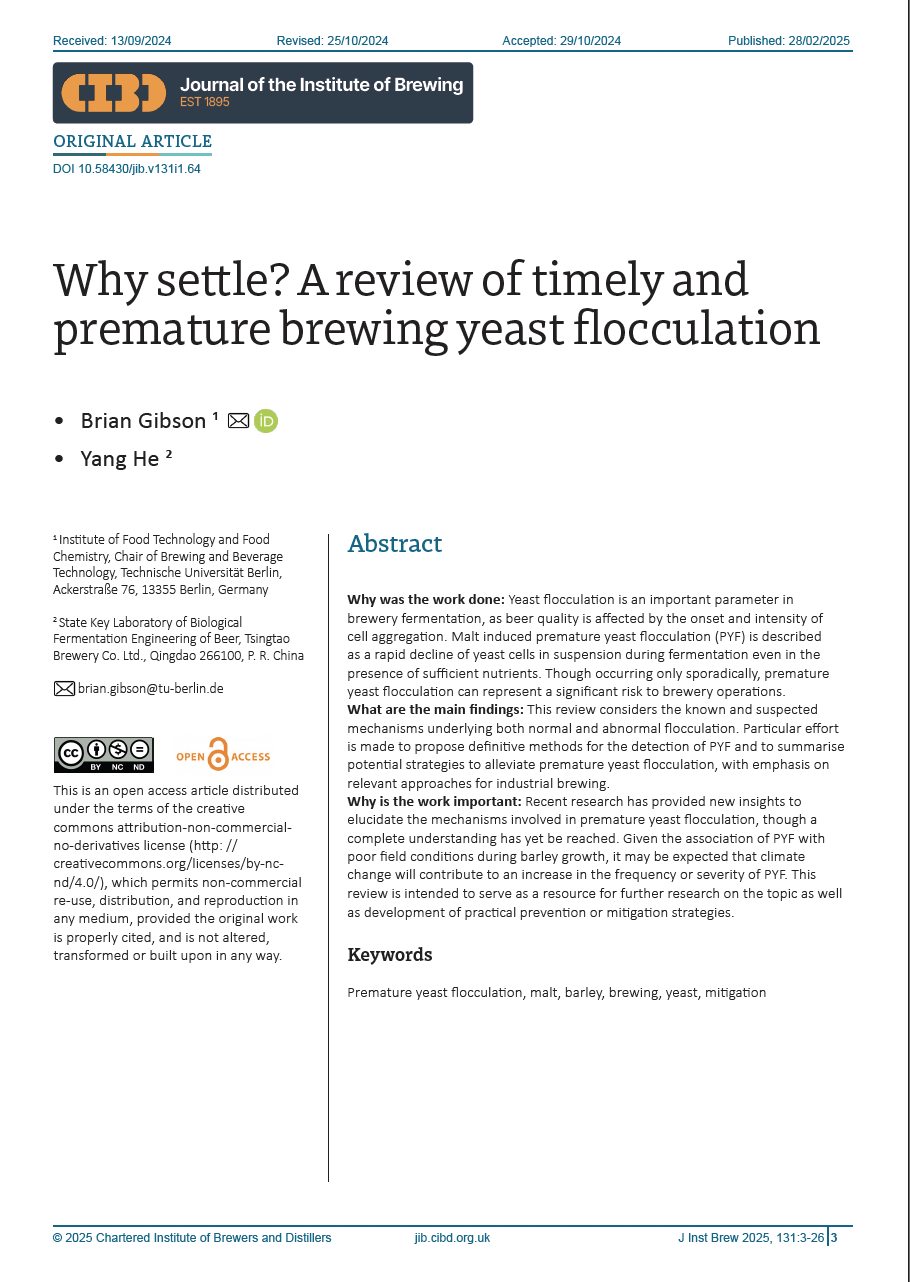
Why settle? A review of timely and premature brewing yeast flocculation
DOI:
https://doi.org/10.58430/jib.v131i1.64Keywords:
premature yeast flocculation, brewing, yeast, mitigation, review, malt, barleyAbstract
Why was the work done: Yeast flocculation is an important parameter in brewery fermentation, as beer quality is affected by the onset and intensity of cell aggregation. Malt induced premature yeast flocculation (PYF) is described as a rapid decline of yeast cells in suspension during fermentation even in the presence of sufficient nutrients. Though occurring only sporadically, premature yeast flocculation can represent a significant risk to brewery operations.
What are the main findings: This review considers the known and suspected mechanisms underlying both normal and abnormal flocculation. Particular effort is made to propose definitive methods for the detection of PYF and to summarise potential strategies to alleviate premature yeast flocculation, with emphasis on relevant approaches for industrial brewing.
Why is the work important: Recent research has provided new insights to elucidate the mechanisms involved in premature yeast flocculation, though a complete understanding has yet be reached. Given the association of PYF with poor field conditions during barley growth, it may be expected that climate change will contribute to an increase in the frequency or severity of PYF. This review is intended to serve as a resource for further research on the topic as well as development of practical prevention or mitigation strategies.
Downloads
References
Adams EL, Kroon PA, Williamson G, Morris VJ. 2005. AFM studies of water-soluble wheat arabinoxylans-effects of esterase treatment. Carbohydr Res 340:1841-1845.
Adom KK, Liu RH. 2002. Antioxidant activity of grains. J Agric Food Chem 50:6182–6187.
Akiyama-Jibiki M, Ishibiki T, Yamashita H, Eto M. 1997. A rapid and simple assay to measure flocculation in brewer's yeast. Tech Q Master Brew Assoc Am 34:278-281.
Ali MS, Baek KH. 2020. Jasmonic acid signaling pathway in response to abiotic stress in plants. Int J Mol Sci 21:621.
American Society of Brewing Chemists. 2011. Methods of Analysis, 12th Ed. Yeast-14 Miniature fermentation assay. ASBC, St. Paul, MN.
Amory DE, Rouxhet PG, Dufour JP. 1988. Flocculence of brewery yeasts and their surface properties: chemical composition, electrostatic charge, and hydrophobicity. J Inst Brew 94:79-84.
Armstrong K, Bendiak D. 2007. PYF malt: practical brewery observations of fermentability. Tech Q Master Brew Assoc Am 44:40–46.
Armstrong M, MacIntosh AJ, Josey M, Speers RA. 2018. Examination of premature yeast flocculation in U.K. Malts. Tech Q Master Brew Assoc Am 55:54–60.
Axcell BC, Tulej R, Mulder CJ. 1986. The influence of the malting process on malt fermentability performance. p 63-69. Proc Inst Brew Conv (Australia & New Zealand). Hobart, Australia.
Axcell B, van Nierop S, Vundla W. 2000. Malt induced premature yeast flocculation. Tech Q Master Brew Assoc Am 37:501–504.
Badea A, Tucker JR, Sabra A, Netticadan T, Blackwell B, Yu L, Kodikara C, Wijekoon C. 2023. Endogenic phenolic compounds of barley as potential biomarkers related to grain mycotoxin production and cultivar selection. Biology 12:1306.
Benabdesselam FM. 2010. Malt factor induced flocculation in Saccharomyces uvarum. Sci Rese Essays 5:2595-2602.
Bouyx C, Schiavone M, François JM. 2021. FLO11, a developmental gene conferring impressive adaptive plasticity to the yeast Saccharomyces cerevisiae. Pathogens 10:1509.
Britton SJ, Neven H, Maskell DL. 2021. Microbial small talk: Does quorum sensing play a role in beer fermentation? J Am Soc Brew Chem 79: 231–239.
Broekaert WF, Mariën W, Terras FR, Mf DB, Proost P, Vandamme J, Dillen L, Claeys M, Rees SB, Vanderleyden J. 1992. Antimicrobial peptides from Amaranthus caudatus seeds with sequence homology to the cysteine/glycine-rich domain of chitin-binding proteins. Biochemistry 31:4308–4314.
Broekaert WF, Terras FR, Cammue BP, Osborn RW. 1995. Plant defensins: novel antimicrobial peptides as components of the host defence system. Plant Physiol 108:1353–1358.
Broekaert WF, Cammue BP, De Bolle MF, Thevissen K, De Samblanx G, Osborn RW, Nielson K. 1997. Antimicrobial peptides from plants. Crit Rev Plant Sci 16:297-323.
Chen W, Cheung HYK, McMillan M, Turkingto TK, Izydorczyk MS, Gräfenhan T. 2022. The dynamics of indigenous epiphytic bacterial and fungal communities of barley grains through the commercial malting process. Curr Res Food Sci 5:1352–1364. 09
Cheremisinov M, Rengarten GA. 2024. Use of biological products on spring barley to inhibit Fusarium fungi. Agrarian Bulletin 24:628-636.
Chtioui W, Balmas V, Delogu G, Migheli Q, Oufensou S. 2022. Bioprospecting phenols as inhibitors of trichothecene-producing Fusarium: sustainable approaches to the management of wheat pathogens. Toxins 14:72.
Coghe S, Benoot K, Delvaux F, Vanderhaegen B, Delvaux FR. 2004. Ferulic acid release and 4-vinylguaiacol formation during brewing and fermentation: indications for feruloyl esterase activity in Saccharomyces cerevisiae. J Agric Food Chem 52:602-608.
Cvetković A, Blagojević S, Hranisavljević J, Vučelić D. 1997. Effects of pathogen-related proteins from barley grain on brewers yeast. J Inst Brew 103:183-186.
Das AK, Singh V. 2015. Antioxidative free and bound phenolic constituents in pericarp, germ and endosperm of Indian dent (Zea mays var. indentata) and flint (Zea mays var. indurata) maize. J Funct Foods 13:363–374.
Dervilly-Pinel G, Rimsten L, Saulnier L, Andersson R, Åman P. 2001. Water-extractable arabinoxylan from pearled flours of wheat, barley, rye and triticale. Evidence for the presence of ferulic acid dimers and their involvement in gel formation. J Cereal Sci 34:207–214.
Etchevers GC, Banasi OJ, Watson CA. 1977. Microflora of barley and its effects on malt and beer properties: A review. Brew Dig.52:46-50.
Evans DE, Kaur M. 2009. Keeping sleepy yeast awake until bedtime: Understanding and avoiding PYF. Brew Distill Int 5:38–40
Evans DE, Paynter BH, Izydorczyk MS, Li C. 2023. The impact of terroir on barley and malt quality – a critical review. J Inst Brew. 129:211-258.
Florack DEA, Stiekema WJ. 1994. Thionins: properties, possible biological roles and mechanisms of action. Plant Mol Biol 26:25-37.
Fujii T, Horie Y. 1975. Some substances in malt inducing early flocculation of yeast. II. Further investigation on a substance isolated from wort inducing early flocculation. Rep Res Lab Kirin Brew Co 18:75-85
Fujino S, Yoshida T. 1976. Premature flocculation of yeast induced by some wort constituents. Rep Res Lab Kirin Brew Co 19:45-53.
Gabriel LC, Rodrigues PC dos S, Angelotti-zampar P, Feksa HR, Tessmann DJ. 2024. Fusarium graminearum infection during the reproductive stages of closed-flowering barley, grain deoxynivalenol contamination, and response to fungicide application. Pesq agropec bras 59:e03459.
Gagiano M, Bauer FF, Pretorius IS. 2002. The sensing of nutritional status and the relationship to filamentous growth in Saccharomyces cerevisiae. FEMS Yeast Res 2: 433–470.
Gagiano M, Bester M, Van Dyk D, Franken J, Bauer F, Pretorius IS. 2003. Mss11p is a transcription factor regulating pseudohyphal differentiation, invasive growth and starch metabolism in Saccharomyces cerevisiae in response to nutrient availability. Mol Microbiol 47: 119–134.
Gancedo JM. 1998. Yeast carbon catabolite repression. Microbiol Mol Biol Rev 62:334-361.
García-Olmedo F, Rodríguez-Palenzuela P, Molina A, Alamillo JM, López-Solanilla E, Berrocal-Lobo M, Poza-Carrión C. 2001. Antibiotic activities of peptides, hydrogen peroxide and peroxynitrite in plant defence. FEBS Lett 498:219-222.
Gibson BR, Lawrence SJ, Leclaire JP, Powell CD, Smart KA. 2007. Yeast responses to stresses associated with industrial brewery handling. FEMS Microbiol Rev 31:535–569.
Goodey AR, Tubb RS. 1982. Genetic and biochemical-analysis of the ability of Saccharomyces cerevisiae to decarboxylate cinnamic-acids. J Gen Microbiol 128: 2615-2620.
Goossens KVY, Ielasi FS, Nookaew I, Stals I, Alonso-Sarduy L, Daenen L, Van Mulders SE, Stassen C, van Eijsden RGE, Siewers V, Delvaux FR, Kasas S, Nielsen J, Devreese B, Willaert RG. 2015. Molecular mechanism of flocculation self-recognition in yeast and its role in mating and survival. mBio 6: e00427-15.
Gorjanović S, Sužnjević D, Beljanski M, Ostojić S, Gorjanović R, Vrvić M, Hranisavljević J. 2004. Effects of lipid-transfer protein from malting barley grain on brewers yeast fermentation. J Inst Brew 110:297–302.
Guo L, Xie X, Zhao N, Wang M, Lin Z, Song Y, Jia F. 2021. Investigation of potential strategies to control malt-induced premature yeast flocculation. Syst Microbiol and Biomanuf 1:193-199.
Halme A, Bumgarner S, Styles C, Fink GR. 2004. Genetic and epigenetic regulation of the FLO gene family generates cell-surface variation in yeast. Cell 116:405–415.
He Y, Yin H, Dong J, Yu J, Zhang L, Yan P, Wan X, Hou X, Zhao Y, Chen R, Gibson B, Krogerus K. 2022. Reduced sensitivity of lager brewing yeast to premature yeast flocculation via adaptive evolution. Food Microbiol 106:104032.
Herrera VE, Axcell BC. 1989. The influence of barley lectins on yeast flocculation. J Am Soc Brew Chem 47:29-34.
Herrera VE, Axcell BC. 1991a. Induction of premature yeast flocculation by a polysaccharide fraction isolated from malt husk. J Inst Brew 97:359-366.
Herrera VE, Axcell BC. 1991b. Studies on the binding between yeast and a malt polysaccharide that induces heavy yeast flocculation. J Inst Brew 97:367-373.
Hope EA, Amorosi CJ, Miller AW, Dang K, Heil CS, Dunham MJ. 2017. Experimental evolution reveals favored adaptive routes to cell aggregation in yeast. Genetics 206:1153-1167.
Hou D, Xu X, Wang J, Liu C, Niu C, Zheng F, Li Q. 2023. Effect of environmental stresses during fermentation on brewing yeast and exploration on the novel flocculation-associated function of RIM15 gene. Bioresource Technol 379: 129004.
Hoy JL, Macauley BJ, Fincher GB. 1981. Cellulases of plant and microbial origin in germinating barley. J Inst Brew 87:77-80.
Izydorczyk MS, Biliaderis CG, Bushuk W. 1990. Oxidative gelation studies of water-soluble pentosans from wheat. J Cereal Sci 11:153-169.
Izydorczyk MS, Biliaderis CG. 1992. Rheological studies on wheat arabinoxylans: effects of structure and molecular size. p 137–140. In ‘Gums and stabilisers for the Food industry’ Vol. 6, (GO Phillips, PA Williams, DJ Wedlock (eds), IRL press, Oxford.
Jibiki M, Sasaki K, Kaganami N, Kawatsura K. 2006. Application of a newly developed method for estimating the premature yeast flocculation potential of malt samples. J Am Soc Brew Chem 64:79-85.
Jin Y, Speers RA. 2000. Effect of environmental conditions on the flocculation of Saccharomyces cerevisiae. J Am Soc Brew Chem 58: 108–
Jin Y, Ritcey LL, Speers RA. 2001. Effect of cell surface hydrophobicity, charge, and zymolectin density on the flocculation of Saccharomyces cerevisiae. J Am Soc Brew Chem 59:1–9.
Jin Z, Solanki S, Ameen G, Gross T, Poudel RS, Borowicz P, Brueggeman RS, Schwarz P. 2021. Expansion of internal hyphal growth in Fusarium Head blight–infected grains contributes to the elevated mycotoxin production during the malting process. Mol Plant Microbe In 34:793–802.
Kanauchi M, Bamforth CW. 2001. Growth of Trichoderma viride on crude cell wall preparations from barley. J Agric Food Chem 49:883-887.
Kaur M, Bowman JP, Stewart DC, Sheehy M, Janusz A, Speers RA, Koutoulis A, Evans DE. 2012. TRFLP analysis reveals that fungi rather than bacteria are associated with premature yeast flocculation in brewing. J Ind Microbiol Biotechnol 39:1821-1832.
Koizumi H, Ogawa T. 2005. Rapid and sensitive method to measure premature yeast flocculation activity in malt. J Am Soc Brew Chem. 63:147–150.
Koizumi H, Kato Y, Ogawa T. 2008. Barley malt polysaccharides inducing premature yeast flocculation and their possible mechanism. J Am Soc Brew Chem 66:137−142.
Koizumi H, Kato Y, Ogawa T. 2009. Structural features of barley malt polysaccharides inducing premature yeast flocculation. J Am Soc Brew Chem 67:129-134.
Krnjaja V, Mandić V, Petrović T, Stanković S, Lučev M, Obradović A, Mićić N. 2024. Fusarium spp. infection, mycotoxin contamination, and some agronomic traits in winter barley as affected by N fertilization under Serbia conditions. Chilean JAR 84:632-643.
Kroon PA, Garcia-Conesa MT, Fillingham IJ, Hazlewood GP, Williamson G. 1999. Release of ferulic acid dehydrodimers from plant cell walls by feruloyl esterases. J Sci Food Agric 79:428–434.
Kruger L, Ryder DS, Alcock C, Murray JP. 1982. Malt quality, prediction of malt fermentability. Part I. Tech Q Master Brew Assoc Am 19:45–51
Kudo S. 1958. Yeast flocculation: On a yeast-flocculating agent from spent grains by acid hydrolysis. Rep Res Lab Kirin Brew Co 1:47-51.
Kudo S. 1959. Flockung der brauerei Hefe: Uber anomale Bruchbildung der Hefe bei der Hauptgӓrung. Rep Res Lab Kirin Brew Co 2:11-19.
Kudo S, Kijima M. 1960. Studies of yeast flocculation: Identification of a yeast-flocculating agent ‘barmigen’ and yeast flocculation caused by the related substances. Rep Res Lab Kirin Brew Co 3:33-37.
Kumawat R, Tomar RS. 2024. Dissecting the role of mitogen-activated protein kinase Hog1 in yeast flocculation. FEBS J 291:3080-3103.
Laitila A. 2007. Microbes in the tailoring of barley malt properties. Ph.D. dissertation, VTT Technical Research Centre of Finland, Espoo, Finland.
Laitila A, Kotaviita E, Peltola P, Home S, Wilhelmson A. 2007. Indigenous microbial community of barley greatly influences grain germination and malt quality. J Inst Brew 113: 9–20.
Lake JC. 2008. Detection of malt inducing premature yeast flocculation: Mechanisms and composition. Ph.D. dissertation, Dalhousie University, Halifax, Nova Scotia.
Lake JC, Speers RA. 2008. A discussion of malt-induced premature yeast flocculation. Tech Q Master Brew Assoc Am 45:253–262.
Lake JC, Speers RA, Porter AV, Gill TA. 2008. Miniaturizing the fermentation assay: Effect of fermentor size and fermentation kinetics on detection of premature yeast flocculation. J Am Soc Brew Chem 66:94-102.
Leah R, Tommerup H, Svendsen I, Mundy J. 1991. Biochemical and molecular characterization of three barley seed proteins with antifungal properties. J Biol Chem 266:1564–1573. h
Loney ER, Inglis PM, Sharp S, Pryde FE, Kent NA, Mellor J, Louis EJ. 2009. Repressive and non-repressive chromatin at native telomeres in Saccharomyces cerevisiae. Epigenet Chromat 2:18.
MacIntosh A, MacLeod A, Beatty A, Eck E, Edney M, Rossnagel B, Speers RA. 2014. Assessing the effect of fungal infection of barley and malt on premature yeast flocculation. J Am Soc Brew Chem 72:66-72.
Madhani H, Fink GR. 1997. Combinatorial control required for the specificity of yeast MAPK signaling. Science 275:1314-7.
Miki BL, Poon NH, James AP, Seligy VL. 1982. Possible mechanism for flocculation interactions governed by gene FLO1 in Saccharomyces cerevisiae. J Bacteriol 150:878–889.
Molina A, García-Olmedo F. 1993. Developmental and pathogen-induced expression of three barley genes encoding lipid transfer proteins. Plant J 4:983–991.
Molina A, Goy PA, Fraile A, Sánchez-Monge R, García-Olmedo F. 1993. Inhibition of bacterial and fungal plant pathogens by thionins of types I and II. Plant Sci 92, 169–177.
Morimoto K, Shimazu T, Fujii T, Horie Y. 1975. Some substances in malt inducing early flocculation of yeast. I. Preliminary investigation on high molecular weight substances in malt and wort. Rep Res Lab Kirin Brew Co 18:63-74.
Nardini M, Ghiselli A. 2004. Determination of free and bound phenolic acids in beer. Food Chem 84:137-143.
Noots I, Delcour JA, Michiels CW. 1999. From field barley to malt: detection and specification of microbial activity for quality aspects. Crit Rev Microbiol 25:121-125.
Ogata T. 2012. Nitrogen starvation induces expression of Lg-FLO1 and flocculation in bottom-fermenting yeast. Yeast 29: 487–494.
Ogata T, Ohtake A, Takeuchi S, Tabuchi M, Nakamura K. 2021. Flocculation type and the Lg-FLO1 gene of bottom-fermenting yeast are derived from top-fermenting yeast. J Am Soc Brew Chem 79:306-313.
Okada T, Yoshizumi H, Terashima Y. 1970. A lethal toxic substance for brewing yeast in wheat and barley. Part I: Assay of toxicity on various grains, and sensitivity to various yeast strains. Part II: Isolation and some properties of toxic principle. Agric Biol Chem 34:1084-1094.
Padder SA, Prasad R, Shah AH. 2018. Quorum sensing: A less known mode of communication among fungi. Microbiol Res 210:51–58.
Pangestu R, Kahar P, Ogino C, Knondo A. 2024. Comparative responses of flocculating and nonflocculating yeasts to cell density and chemical stress in lactic acid fermentation. Yeast 41:192-206.
Panteloglou AG, Box WG, Smart KA, Cook DJ. 2010. Optimization of a small-scale fermentation test to predict the premature yeast flocculation potential of malts. J Inst Brew 116:413–420.
Panteloglou AG, Smart KA, Cook DJ. 2012. Malt-induced premature yeast flocculation: current perspectives. J Ind Microbiol Biotrchnol 39:813–822.
Panteloglou AG, Smart KA, Cook DJ. 2013. Impacts of premature yeast flocculation factors on yeast physiological characteristics and metabolite profiles during stirred and unstirred high-gravity fermentations. J Am Soc Brew Chem 71:214-223.
Ponts N, Pinson-Gadais L, Boutigny AL, Barreau C, Richard-Forget F. 2011. Cinnamic-derived acids significantly affect Fusarium graminearum growth and in vitro synthesis of type B trichothecenes. Phytopathology 101:929–934.
Porter AV, Lake JC, Gill TA, Speers RA. 2010. A method to detect anti-metabolic factors in fermentations. J Inst Brew 116:280- 284. h
Powell CD, Quain DE, Smart KA. 2003. The impact of brewing yeast cell age on fermentation performance, attenuation and flocculation. FEMS Yeast Res 3:149-157.
Powell CD, Diacetis AN. 2007. Long term serial repitching and the genetic and phenotypic stability of brewer’s yeast. J Inst Brew 113:67-74.
Quain DE. 2006. Yeast genetics in brewing: new insights and opportunities, p 149-166. In Bamforth CW (ed), Brewing-New Technologies, Woodhead Publishing, Cambridge, England.
Qin Q, Liu J, Hu S, Yu J, Zhang L, Huang S, Yang M, Wang L. 2023. Exploring fungal species diversity in the premature yeast flocculation (PYF) of barley malt using deep sequencing. J Am Soc Brew Chem 81:333-339.
Reboredo NM, Siero C, Blanco P, Villa TG. 1996. Isolation and characterization of a mutant of Saccharomyces cerevisiae affected in the FLO1 locus. FEMS Microbiol Lett 137:57–61.
Richard G, Dujon B. 2006. Molecular evolution of minisatellites in hemiascomycetous yeasts. Mol Biol Evol 23:189–202.
Rodríguez‑Vázquez R, Carrieri V. 2024. A proteomic approach to abiotic and biotic stress in barley: a review. Plant Mol Biol Rep 42:1-33.
Rolland T, Dujon B, Richard G. 2010. Dynamic evolution of megasatellites in yeasts. Nucleic Acids Res 38:4731–4739.
Rossouw D, Meiring SP, Bauer FF. 2018. Modifying Saccharomyces cerevisiae adhesion properties regulates yeast ecosystem dynamics. mSphere 3:e00383-18.
Rudolph A, MacIntosh AJ, Speers RA, St. Mary C. 2020. Modelling yeast in suspension during laboratory and commercial fermentations to detect aberrant fermentation processes. J Am Soc Brew Chem 78:63–73.
Rupp S, Summers E, Lo HJ, Madhani H, Fink G. 1999. MAP kinase and cAMP filamentation signaling pathways converge on the unusually large promoter of the yeast FLO11 gene. EMBO J. 18:1257–1269.
Saguez C, Viterbo D, Descorps-Declère S, Cormack BP, Dujon B, Richard G. 2022. Functional variability in adhesion and flocculation of yeast megasatellite genes. Genetics 221:iyac042.
Saijo Y, Loo EP. 2020. Plant immunity in signal integration between biotic and abiotic stress responses. New Phytol 225: 87–104.
Sampermans S, Mortier J, Soares EV. 2005. Flocculation onset in Saccharomyces cerevisiae: the role of nutrients. J Appl Microbiol 98: 525–531.
Sarlin T, Kivioja T, Kalkkinen N, Linder MB, Nakari-Setälä T. 2012. Identification and characterization of gushing-active hydrophobins from Fusarium graminearum and related species. J Basic Microbiol 52:184–194.
Sato M, Watari J, Shinotsuka K. 2001. Genetic instability in flocculation of bottom-fermenting yeast. J Am Soc Brew Chem 59:130–134.
Sato M, Maeba H, Watari J, Takashio M. 2002. Analysis of an inactivated Lg-FLO1 gene present in bottom-fermenting yeast. J Biosci Bioeng 93:395–398.
Schuster M, Sexton DJ, Hense BA. 2017. Why quorum sensing controls private goods. Front Microbiol 8: 885.
Schwartz MA, Madhani HD. 2004. Principles of MAP kinase signaling specificity in Saccharomyces cerevisiae. Annu Rev Genet 38:725–748.
Schwarz PB, Jones BL, Steffenson BJ. 2002. Enzymes associated with Fusarium infection of barley. J Am Soc Brew Chem 60:130-134.
Shang Y, Li X, Cai G, Lu J, Chen J. 2014. Premature yeast flocculation factors from barley malt present in both malt husk and the non-husk part. J Inst Brew 120:220-224.
Shang Y, Li X, Cai G, Lu J. 2015. The role of ferulic acid and arabinoxylan in inducing premature yeast flocculation. J Inst Brew 121:49-54.
Shang Y, Li X, Cai G, Wang D, Li F, Lu J, Yu X. 2022. Production of recombinant barley xylanase inhibitor in Pichia pastoris and its inhibitory effect on premature yeast flocculation. J Inst Brew 128:59-65.
Sieiro C, Reboredo NM, Villa TG. 1995. Flocculation of industrial and laboratory strains of Saccharomyces cerevisiae. J Ind Microbiol 14:461–6.
Singh B, Gupta KG, Gupta GS. 1972. Incidence of antibacterial compounds in fungi. Indian J Exp Biol 10:228-231
Smit G, Straver MH, Lugtenberg BJ, Kijne JW. 1992. Flocculence of Saccharomyces cerevisiae cells is induced by nutrient limitation, with cell surface hydrophobicity as a major determinant. Appl Environ Microbiol 58: 3709–3714.
Smukalla S, Caldara M, Pochet N, Beauvais A, Guadagnini S, Yan C, Vinces MD, Jansen A, Prevost MC, Latgé J, Fink GR, Foster KR, Verstrepen KJ. 2008. FLO1 is a variable green beard gene that drives biofilm-like cooperation in budding yeast. Cell 135:726–737.
Soares EV, Duarte AA. 2002. Addition of nutrients induce a fast loss of flocculation in starved cells of Saccharomyces cerevisiae. Biotechnol Lett 24:1957–1960.
Soares EV. 2011. Flocculation in Saccharomyces cerevisiae: a review. J Appl Microbiol 110:1–18.
Speers RA, Wan YQ, Jin YL, Stewart RJ. 2006. Effects of fermentation parameters and cell wall properties on yeast flocculation. J Inst Brew 112:246–254.
Speers A. 2016. Brewing fundamentals, Part 3: yeast settling-flocculation. Tech. Q. Master Brew Assoc Am 53: 17–22.
Stewart GG. 2009. The Horace Brown Medal lecture: forty years of brewing research. J Inst Brew 115:3–29.
Stewart GG. 2018. Yeast flocculation-sedimentation and flotation. Fermentation 4:28.
Stratford M. 1989a. Evidence for two mechanisms of flocculation in Saccharomyces cerevisiae. Yeast 5: S441–5.
Stratford M. 1989b. Yeast flocculation: Calcium specificity. Yeast 5:487–496.
Stratford M, Assinder S. 1991. Yeast flocculation: Flo1 and NewFlo phenotypes and receptor structure. Yeast 7: 559–574.
Stratford M. 1992. Yeast flocculation: a new perspective. Adv Microb Physiol 33:1–71.
Straver MH, Kijne JW, Smit G. 1993a. Cause and control of flocculation in yeast. Trends Biotechnol 11:228-232.
Straver MH, vd Aar PC, Smit G, Kijne JW. 1993b. Determinants of flocculence of brewer’s yeast during fermentation in wort. Yeast 9: 527–532.
Straver MH, Traas VM, Smit G, Kijne JW. 1994. Isolation and partial purification of mannose-specific agglutinin from brewer’s yeast involved in flocculation. Yeast 10:1183-1193.
Straver MH, Kijne JW. 1996. A rapid and selective assay for measuring cell surface hydrophobicity of brewer’s yeast cells. Yeast 12:207-213.
Sørensen HR, Pedersen S, Meyer AS. 2007. Characterization of solubilized arabinoxylo-oligosaccharides by MALDI-TOF MS analysis to unravel and direct enzyme catalyzed hydrolysis of insoluble wheat arabinoxylan. Enzyme Microb Technol 41:103-110.
Taylor NW, Orton WL. 1975. Calcium in flocculence of Saccharomyces cerevisiae. J Inst Brew 81:53–57.
Tekaia F, Dujon B, Richard G. 2013. Detection and characterization of megasatellites in orthologous and nonorthologous genes of 21 fungal genomes. Eukaryot Cell 12:794–803.
Thevissen K, Cammue BP, Lemaire K, Winderickx J, Dickson RC, Lester RL, Ferket KK, Van Even F, Parret AH, Broekaert WF. 2000. A gene encoding a sphingolipid biosynthesis enzyme determines the sensitivity of Saccharomyces cerevisiae to an antifungal plant defensin from dahlia (Dahlia merckii). Proc Natl Acad Sci USA 97:9531-9536.
van Nierop S, Cameron-Clarke A, Axcell BC. 2004. Enzymatic generation of factors from malt responsible for premature yeast flocculation. J Am Soc Brew Chem 62:108-116.
van Nierop S. 2005. Investigation of malt factors that influence beer production and quality. Ph.D. dissertation. University of Stellenbosch, Stellenbosch, South Africa.
van Nierop S, Rautenbach M, Axcell BC, Cantrell IC. 2006. The impact of microorganisms on barley and malt quality—A review. J Am Soc Brew Chem 64:69-78.
van Nierop S, Axcell BC, Cantrell IC, Rautenbach M. 2008. Optimised quantification of the antiyeast activity of different barley malts towards a larger brewing yeast strain. Food Microbiol 25: 895– 901.
Verstrepen KJ, Derdelinckx G, Verachtert H, Delvaux FR. 2003. Yeast flocculation: what brewers should know. Appl Microbiol Biotechnol 61:197–205.
Verstrepen KJ, Reynolds TB, Fink GR. 2004. Origins of variation in the fungal cell surface. Nat Rev Microbiol 2: 533–540. 7
Verstrepan KJ, Klis FM. 2006. Flocculation, adhesion and biofilm formation in yeasts. Mol Microbiol 60:5–15.
Vidgren V, Londesborough J. 2011. 125th anniversary review: yeast flocculation and sedimentation in Brewing. J Inst Brew 117:475–487.
Vyas VK, Kuchin S, Berkey CD, Carlson M. 2003. Snf1 kinases with different beta-subunit isoforms play distinct roles in regulating haploid invasive growth. Mol Cell Biol 23: 1341–1348.
Wang DW, Chen YY, Jarin M, Xie X. 2022. Increasingly frequent extreme weather events urge the development of point-of-use water treatment systems. npj Clean Water 5: 36.
Westman JO, Franzén CJ. 2015. Current progress in high cell density yeast bioprocesses for bioethanol production. Biotechnol J 10:1185–1195.
Xie W, Xiong W, Pan J, Ali T, Cui Q, Guan D, Meng J, Mueller ND, Lin E, Davis SJ. 2018. Decreases in global beer supply due to extreme drought and heat. Nat Plants 4:964-973.
Xie Y, Xu M, Han B, Chen T, Cai G, Lu J. 2022. Barley husk degraded by Fusarium graminerarum MH1 induced premature yeast flocculation. J Agric Food Chem 70:10296-10304.
Yoshida T, Yamada K, Fujino S, Koumegawa J. 1979. Effect of pressure on physiological aspects of germinating barleys and quality of malts. J Am Soc Brew Chem 37:77-84.
Zarattini RD, Williams JW, Ernandez JR, Stewart GG. 1993. Bacterial-induced flocculation in selected brewing strains of Saccharomyce. Biotechnol 18:65-70.
Zhang H, Zhu J, Gong Z, Zhu JK. 2022. Abiotic stress responses in plants. Nat Rev Genet 23:104-119.
Downloads
Published
Versions
- 01-05-2025 (3)
- 28-02-2025 (2)
- 28-02-2025 (1)
How to Cite
Issue
Section
License
Copyright (c) 2025 Journal of the Institute of Brewing

This work is licensed under a Creative Commons Attribution-NonCommercial-NoDerivatives 4.0 International License.
This is an open access article which permits non-commercial re-use, distribution, and reproduction in any medium, provided the original work is properly cited, and is not altered, transformed or built upon in any way.
Permission will be required if the proposed reuse is not covered by the terms of the License. In this event, email the Editor in Chief - david.quain@cibd.org.uk - with details of your request.