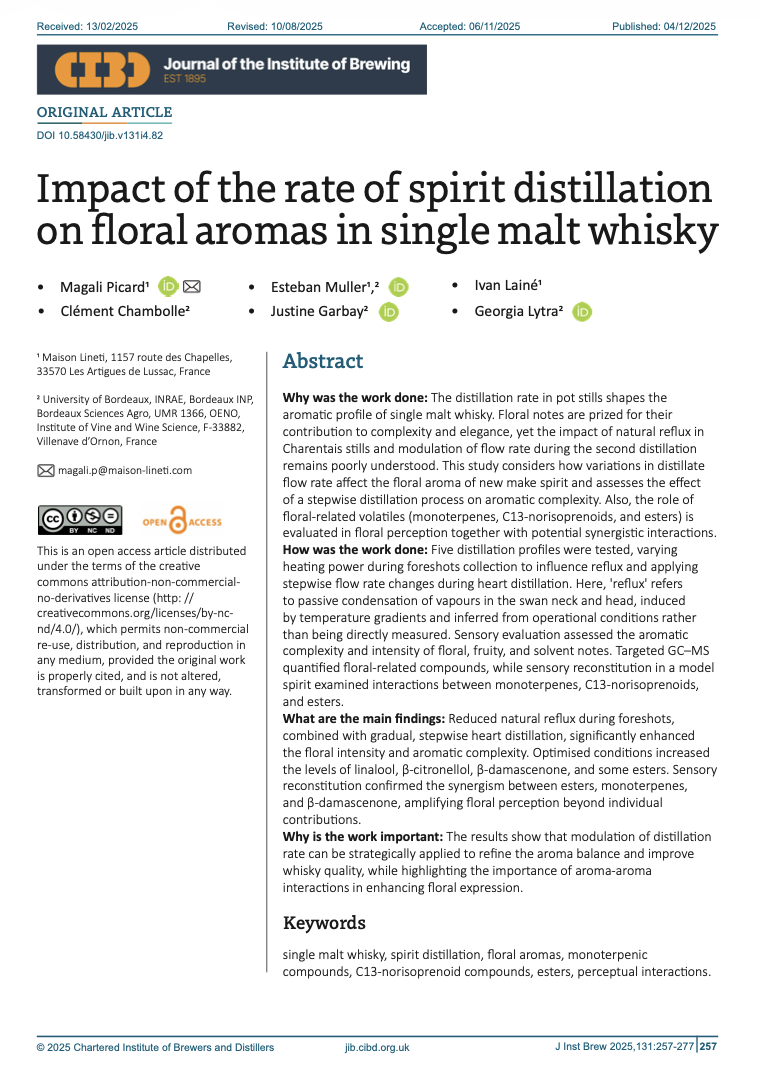
Impact of the rate of spirit distillation on floral aromas in single malt whisky
DOI:
https://doi.org/10.58430/jib.v131i4.82Keywords:
single malt whisky, spirit distillation, floral aromas, monoterpenic compounds, C13-norisoprenoid compounds, esters, perceptual interactionsAbstract
Why was the work done: The distillation rate in pot stills shapes the aromatic profile of single malt whisky. Floral notes are prized for their contribution to complexity and elegance, yet the impact of natural reflux in Charentais stills and modulation of flow rate during the second distillation remains poorly understood. This study considers how variations in distillate flow rate affect the floral aroma of new make spirit and assesses the effect of a stepwise distillation process on aromatic complexity. Also, the role of floral-related volatiles (monoterpenes, C13-norisoprenoids, and esters) is evaluated in floral perception together with potential synergistic interactions.
How was the work done: Five distillation profiles were tested, varying heating power during foreshots collection to influence reflux and applying stepwise flow rate changes during heart distillation. Here, 'reflux' refers to passive condensation of vapours in the swan neck and head, induced by temperature gradients and inferred from operational conditions rather than being directly measured. Sensory evaluation assessed the aromatic complexity and intensity of floral, fruity, and solvent notes. Targeted GC–MS quantified floral-related compounds, while sensory reconstitution in a model spirit examined interactions between monoterpenes, C13-norisoprenoids, and esters.
What are the main findings: Reduced natural reflux during foreshots, combined with gradual, stepwise heart distillation, significantly enhanced the floral intensity and aromatic complexity. Optimised conditions increased the levels of linalool, β-citronellol, β-damascenone, and some esters. Sensory reconstitution confirmed the synergism between esters, monoterpenes, and β-damascenone, amplifying floral perception beyond individual contributions.
Why is the work important: The results show that modulation of distillation rate can be strategically applied to refine the aroma balance and improve whisky quality, while highlighting the importance of aroma-aroma interactions in enhancing floral expression.
Downloads
References
Antalick G, Perello MC, de Revel G. 2010. Development, validation and application of a specific method for the quantitative determination of wine esters by headspace-solid-phase microextraction-gas chromatography–mass spectrometry. Food Chem 121:1236-1245.
Awad P, Athès V, Decloux ME, Ferrari G, Snakkers G, Raguenaud P, Giampaoli P. 2017. Evolution of volatile compounds during the distillation of cognac spirit. J Agric Food Chem 65:7736-7748.
Binati RL, Junior WJL, Luzzini G, Slaghenaufi D, Ugliano M, Torriani S. 2020. Contribution of non-Saccharomyces yeasts to wine volatile and sensory diversity: A study on Lachancea thermotolerans, Metschnikowia spp. and Starmerella bacillaris strains isolated in Italy. Int J Food Microbiol 318:108470.
Bougas NV. 2009. Evaluating the effect of pot still design on the resultant distillate. PhD dissertation, University of Stellenbosch.
Broom D. 2014. The World Atlas of Whisky: More Than 200 Distilleries Explored and 750 Expressions Tasted. Octopus Publishing Group, London, England.
Cain WS, Drexler M. 1974. Scope and evaluation of odor counteraction and masking. Ann N Y Acad Sci 237:427–439.
Cantagrel, R. 1989. A scientific approach to quality control for Cognac spirits, p 117-132. In Piggott JR, Paterson A (eds) Distilled Beverage Flavour, Ellis Horwood Chichester.
Christoph N, Bauer-Christoph C. 2007. Flavour of spirit drinks: Raw materials, fermentation, distillation, and ageing pp. 219-239. In Berger RG (ed) Flavours and Fragrances: Chemistry, Bioprocessing and Sustainability, Heidelberg: Springer, Berlin, Germany.
Douady A, Puentes C, Awad P, Esteban-Decloux M. 2019. Batch distillation of spirits: Experimental study and simulation of the behaviour of volatile aroma compounds. J Inst Brew 125:268–283.
Esteban‐Decloux M, Tano N. G. C. R, Grangeon H. 2022. Simulation of the behaviour of volatile compounds during batch multi‐stage distillation of whisky. J Inst Brew 128:171-187.
Ferremi Leali N, Salvetti E, Luzzini G, Salini A, Slaghenaufi D, Fusco S, Binati RL. 2024. Differences in the volatile profile of apple cider fermented with Schizosaccharomyces pombe and Schizosaccharomyces japonicus. Fermentation 10:128.
Garbay J, Cameleyre M, Riquier L, Barbe JC, Lytra G. 2023. Development of a new method for the quantitative analysis of aroma compounds potentially related to the fruity aroma of red wines. J Agric Food Chem 71:13066-13078.
Garbay J, Cameleyre M, Le Menn N, Riquier L, Barbe JC, Lytra G. 2024. Study of the fruity aroma of red wines made from grape varieties potentially adapted to climate change using a semi-preparative HPLC method. LWT 204:116481.
García‐Llobodanin L, Roca J, López JR, Pérez‐Correa JR, López F. 2011. The lack of reproducibility of different distillation techniques and its impact on pear spirit composition. Int J Food Sci Technol 46:1956-1963.
Guo S, Wang D, Li Y, Li J, Du J. 2024. Comparison of aroma profiles of whiskeys fermented from different grain ingredients. Foods 13:2031.
Huang H, Chen Y, Hong J, Chen H, Zhao D, Wu J, Sun B. 2024. Unravelling the chemosensory characteristics on different types of spirits based on sensory contours and quantitative targeted flavouromics analysis. Food Chem X 23:101716.
Jackson M. 1994. Michael Jackson's Complete Guide to Single Malt Scotch: A Connoisseur's Guide to the Single Malt Whiskies of Scotland. Running Press, Philadelphia, PA, US
Kelly TJ, O’Connor C, Kilcawley KN. 2023. Sources of volatile aromatic congeners in whiskey. Beverages 9:64.
Lavit C, Escoufier Y, Sabatier R, Traissac P. 1994. The ACT (STATIS method). Comput Stat Data Anal 18:97-119.
Léauté R. 1990. Distillation in alambic. Am J Enol Vitic 41:90-103.
Liu Z, Yang K, He Z, Zhao D, Zheng J, Qian MC. 2023. Comparison of two data processing approaches for aroma marker identification in different distilled liquors using comprehensive two-dimensional gas chromatography-time-of-flight mass spectrometry dataset. J Food Sci 88:2870-2881.
Lukić I, Tomas S, Miličević B, Radeka, S, Peršurić D. 2011. Behaviour of volatile compounds during traditional alembic distillation of fermented Muscat Blanc and Muškat Ruža Porečki grape marcs. J Inst Brew 117:440-450.
Luzzini G, Slaghenaufi D, Ugliano M. 2021. Volatile compounds in monovarietal wines of two Amarone della Valpolicella terroirs: Chemical and sensory impact of grape variety and origin, yeast strain and spontaneous fermentation. Foods 10:2474.
Lytra G, Tempere S, de Revel G, Barbe JC. 2012. Distribution and organoleptic impact of ethyl 2-hydroxy-4-methylpentanoate enantiomers in wine. J Agric Food Chem 60:1503-1509.
Lytra G, Tempere S, Le Floch A, de Revel G, Barbe JC. 2013. Study of sensory interactions among red wine fruity esters in a model solution. J Agric Food Chem 61:8504-8513.
MacLean C. 2003. Scotch Whisky: A Liquid History. Cassell Illustrated, London, England.
Madrera, R. 2003. Influence of distillation system, oak wood type, and aging time on the volatile compounds of cider brandy. J Agric Food Chem 51:5709-5714.
Matias-Guiu P, Rodríguez-Bencomo JJ, Orriols I, Pérez-Correa JR, López F. 2016. Floral aroma improvement of muscat spirits by packed column distillation with variable internal reflux. Food Chem 213:40-48.
Matias-Guiu P, Rodríguez-Bencomo JJ, Pérez-Correa JR, López F. 2018. Aroma profile design of wine spirits: Multi-objective optimisation using response surface methodology. Food Chem 245:1087-1097.
Mendes-Pinto MM. 2009. Carotenoid breakdown products the-norisoprenoids-in wine aroma. Arch Biochem Biophys 483:236-245.
Miller GH. 2024. Maturation, p 377-478. Whisky Science: A Condensed Distillation (Springer International Publishing.
Paterson R. 2011. Goodness Nose: The Passionate Revelations of a Scotch Whisky Master Blender. Neil Wilson Publishing, Glasgow, Scotland.
Pelonnier-Magimel E, Windholtz S, Pomarède IM, Barbe JC. 2020. Sensory characterisation of wines without added sulfites via specific and adapted sensory profile. Oeno One 54:671-685.
Picard M, Tempere S, De Revel G, Marchand S. 2015. A sensory study of the ageing bouquet of red Bordeaux wines: A three-step approach for exploring a complex olfactory concept. Food Qual Prefer 42:110-122.
Picard M, Oulieu C, Nonier MF, Vivas N, Vivas N. 2023. The role of oak wood in the mint and floral notes of whisky: identification of common terpenoids by aromatic fractionation. J Inst Brew 129:62-79.
Pineau B, Barbe JC, Van Leeuwen C, Dubourdieu D. 2007. Which impact for β-damascenone on red wines aroma? J Agric Food Chem 55:4103-4108.
Piggott JR, Conner JM. 2003. Whiskies, p 239-262. In Lea AGH, Piggott JR (eds) Fermented Beverage Production, CRC Press, Boca Raton, FL, USA.
Plantevin M, Thibon C, Barbe JC, Lecourt J, Dijkstra L, Lytra G, van Leeuwen C. 2024. The varietal effect on the wine volatile composition: a large study covering 23 red varieties over several vintages. Pre-print.
Poisson L, Schieberle P. 2008. Characterization of the key aroma compounds in American Bourbon whisky by quantitative measurements, aroma recombination, and omission studies. J Agric Food Chem 56:5820-5826.
Puentes C, Joulia X, Vidal JP, Esteban-Decloux M. 2018. Simulation of spirits distillation for a better understanding of volatile aroma compounds behaviour: Application to Armagnac production. Food Bioprod Process 112:31-62.
Rodríguez-Bencomo JJ, Pérez-Correa JR, Orriols I, López F. 2016. Spirit distillation strategies for aroma improvement using variable internal column reflux. Food Process Technol 9:1885-1892.
Thomas-Danguin T, Sinding C, Romagny S, El Mountassir F, Atanasova B, Le Berre E, Le Bon AM, Coureaud G. 2014. The perception of odor objects in everyday life: a review on the processing of odor mixtures. Front Psychol 5.
Salo P, Nykänen L, Suomalainen H. 1972. Odor thresholds and relative intensities of volatile aroma components in an artificial beverage imitating whisky. J Food Sci 37:394-398.
Shen X, Wang H, Zhuang H, Yao L, Sun M, Yu C, Feng T. 2024. Comparative analysis of the aromatic profile of single malt whiskies from different regions of Scotland using GC-MS, GC-O-MS and sensory evaluation. J Food Compos Anal 133:106465.
Stewart G, Russell I. 2014. Whisky: Technology, Production and Marketing. Elsevier Publishing.
Vriesekoop F, Ostrowski D. 2017. Distillation processes and distillates, p. 41-80. In Bordiga M (ed), Post-Fermentation and Distillation Technology: Stabilization, Aging, and Spoilage. CRC Press.
Zanghelini G, Giampaoli P, Athès V, Vitu S, Wilhelm V, Esteban-Decloux M. 2024a. Charentaise distillation of cognac. Part I: Behavior of aroma compounds. Food Res Int 178:113977.
Zanghelini G, Athès V, Vitu S, Giampaoli P, Esteban-Decloux M. 2024b. Charentaise distillation of cognac. Part II: Process simulation and impact of recycling practices on the aroma composition of freshly distilled spirit. Food Res Int 178:113861.
Downloads
Published
Versions
- 28-01-2026 (2)
- 04-12-2025 (1)
How to Cite
Issue
Section
License
Copyright (c) 2025 Journal of the Institute of Brewing

This work is licensed under a Creative Commons Attribution-NonCommercial-NoDerivatives 4.0 International License.
This is an open access article which permits non-commercial re-use, distribution, and reproduction in any medium, provided the original work is properly cited, and is not altered, transformed or built upon in any way.
Permission will be required if the proposed reuse is not covered by the terms of the License. In this event, email the Editor in Chief - david.quain@cibd.org.uk - with details of your request.