Whisky innovation using Patagonian yeasts to diversify flavour and aroma
DOI:
https://doi.org/10.58430/jib.v131i3.78Keywords:
whisky, non-conventional yeasts, mixed fermentations, beverage innovation, flavourAbstract
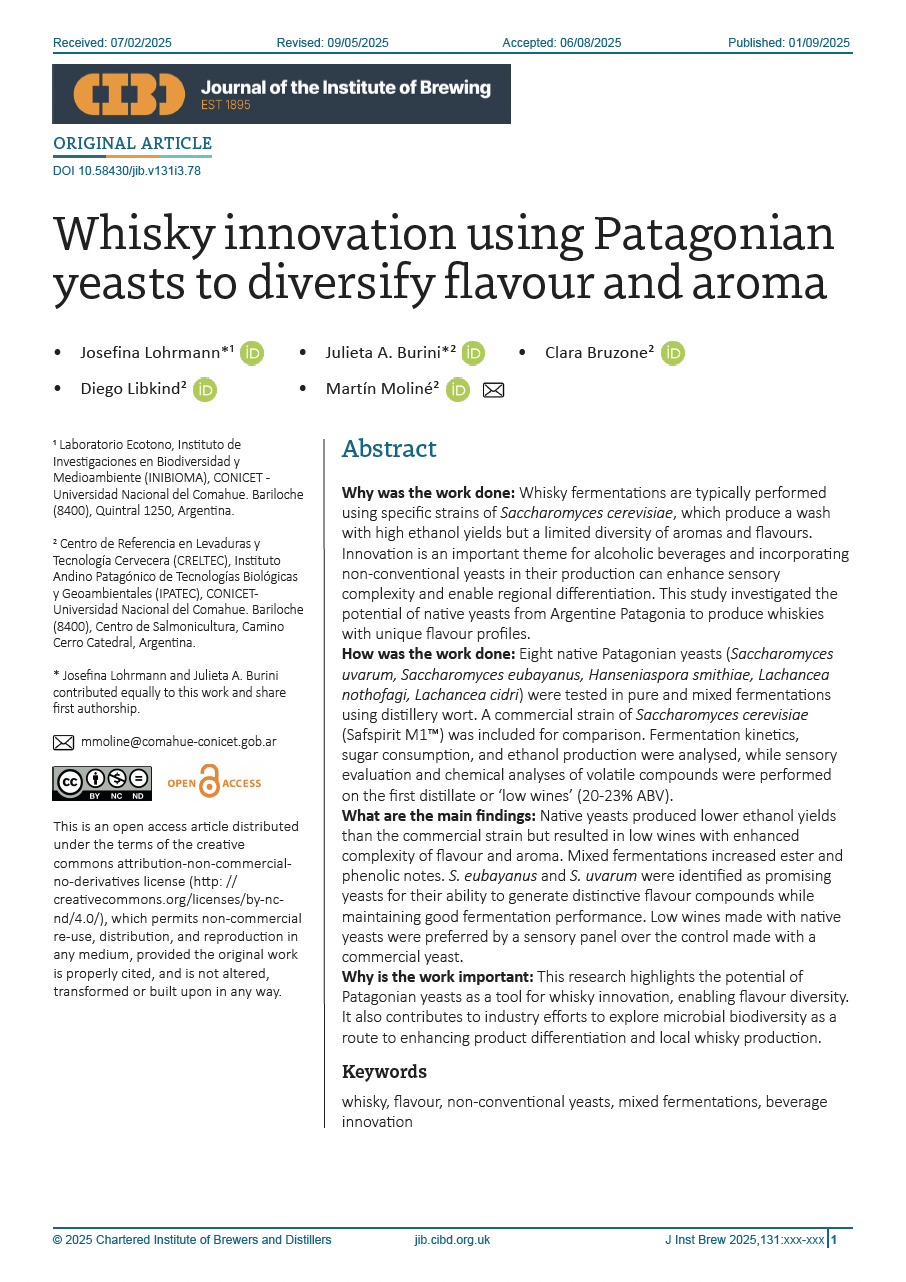
Why was the work done: Whisky fermentations are typically performed using specific strains of Saccharomyces cerevisiae, which produce a wash with high ethanol yields but a limited diversity of aromas and flavours. Innovation is an important theme for alcoholic beverages and incorporating non-conventional yeasts in their production can enhance sensory complexity and enable regional differentiation. This study investigated the potential of native yeasts from Argentine Patagonia to produce whiskies with unique flavour profiles.
How was the work done: Eight native Patagonian yeasts (Saccharomyces uvarum, Saccharomyces eubayanus, Hanseniaspora smithiae, Lachancea nothofagi, Lachancea cidri) were tested in pure and mixed fermentations using distillery wort. A commercial strain of Saccharomyces cerevisiae (Safspirit M1™) was included for comparison. Fermentation kinetics, sugar consumption, and ethanol production were analysed, while sensory evaluation and chemical analyses of volatile compounds were performed on the first distillate or ‘low wines’ (20-23% ABV).
What are the main findings: Native yeasts produced lower ethanol yields than the commercial strain but resulted in low wines with enhanced complexity of flavour and aroma. Mixed fermentations increased ester and phenolic notes. S. eubayanus and S. uvarum were identified as promising yeasts for their ability to generate distinctive flavour compounds while maintaining good fermentation performance. Low wines made with native yeasts were preferred by a sensory panel over the control made with a commercial yeast.
Why is the work important: This research highlights the potential of Patagonian yeasts as a tool for whisky innovation, enabling flavour diversity. It also contributes to industry efforts to explore microbial biodiversity as a route to enhancing product differentiation and local whisky production.
Downloads
References
Aguiar-Cervera J, Visinoni F, Zhang P, Hollywood K, Vrhovsek U, Severn O, Delneri D. 2024. Effect of Hanseniaspora vineae and Saccharomyces cerevisiae co-fermentations on aroma compound production in beer. Food Microbiol 104585.
Albergaria H, Francisco D, Gori K, Arneborg N, Gírio F. 2010. Saccharomyces cerevisiae CCMI 885 secretes peptides that inhibit the growth of some non-Saccharomyces wine-related strains. Appl Microbiol Biotechnol 86:965-972.
American Society of Brewing Chemists. Methods of Analysis, 8th ed. Selection and training of assessors. The Society, St. Paul, MN, 1984, rev. 2009.
American Society of Brewing Chemists. Methods of Analysis, 8th ed. Descriptive analysis. The Society, St. Paul, MN, 1983, rev. 2009.
American Society of Brewing Chemists. Methods of Analysis, 8th ed. Flavor terminology and reference standards. The Society, St. Paul, MN, 1986.
Aylott R. 2014. Whisky analysis, p 123-146. In Russell I, Stewart GG (eds), Whisky: Technology, Production and Marketing, Elsevier, UK.
Bellut K, Krogerus K, Arendt EK. 2020. Lachancea fermentati strains isolated from kombucha: fundamental insights, and practical application in low alcohol beer brewing. Front Microbiol 11:764.
Benito Á, Calderón F, Benito S. 2016. Combined use of S. pombe and L. thermotolerans in winemaking. Beneficial effects determined through the study of wines’ analytical characteristics. Molecules 21:1744.
Branco P, Francisco D, Chambon C, Hébraud M, Arneborg N, Almeida MG, Caldeira J, Albergaria H. 2014. Identification of novel GAPDH-derived antimicrobial peptides secreted by Saccharomyces cerevisiae and involved in wine microbial interactions. Appl Microbiol Biotechnol 98:843-853.
Burini JA, Eizaguirre JI, Loviso C, Libkind D. 2021. Non-conventional yeasts as tools for innovation and differentiation in brewing. Rev Argent Microbiol 53:359-377.
Burini JA, Eizaguirre JI, Loviso C, Libkind D. 2022. Selection of Saccharomyces eubayanus strains from Patagonia (Argentina) with brewing potential and performance in the craft beer industry. Eur Food Res Technol 1-13.
Campbell I. 2003. Wild yeasts in brewing and distilling, p 247–266. In Priest FG, Campbell I (eds), Brewing Microbiology, Springer US, Boston, MA.
Canonico L, Galli E, Ciani E, Comitini F, Ciani M. 2019. Exploitation of three non-conventional yeast species in the brewing process. Microorganisms 7:11.
Cubillos FA, Gibson B, Grijalva‐Vallejos N, Krogerus K, Nikulin J. 2019. Bioprospecting for brewers: Exploiting natural diversity for naturally diverse beers. Yeast 36:383–398.
Daute M, Jack F, Harrison B, Walker G. 2021. Experimental whisky fermentations: Influence of wort pretreatments. Foods 10:2755.
Daute M. 2022. Exploiting yeast diversity in whisky fermentations for biocatalysis of desirable flavour compounds. PhD thesis, Abertay University.
Daute M, Jack F, Walker G. 2024. The potential for Scotch malt whisky flavour diversification by yeast. FEMS Yeast Res foae017.
Domizio P, Lencioni L, Ciani M, Di Blasi S, Pontremolesi C, Sabatelli MP. 2007. Spontaneous and inoculated yeast populations dynamics and their effect on organoleptic characters of Vinsanto wine under different process conditions. Int J Food Microbiol 115:281-289.
Domizio P, House JF, Joseph CML, Bisson LF, Bamforth CW. 2016. Lachancea thermotolerans as an alternative yeast for the production of beer. J Inst Brew 122:599-604.
Duarte WF, Amorim JC, Schwan RF. 2013. The effects of co-culturing non-Saccharomyces yeasts with S. cerevisiae on the sugar cane spirit (cachaça) fermentation process. Antonie Van Leeuwenhoek 103:175–94.
Esteban-Decloux M, N’Guessan T, Grangeon H. 2023. Behaviour of volatile compounds during batch multi-stage distillation of whisky: experimental and simulation data. J Inst Brew 129:192–208.
Evans DE, Goldsmith M, Dambergs R, Nischwitz R. 2011. A comprehensive revaluation of small-scale congress mash protocol parameters for determining extract and fermentability. J Am Soc Brew Chem 69:13–27.
Fleet GH. 1998. The microbiology of alcoholic beverages, p 217-262. In Wood BJB (ed), Microbiology of Fermented Foods, Springer, US.
Fleet GH. 2003. Yeast interactions and wine flavour. Int J Food Microbiol 86:11-22.
Flores MG, Rodríguez ME, Origone AC, Oteiza JM, Querol A, Lopes CA. 2019. Saccharomyces uvarum isolated from Patagonian ciders shows excellent fermentative performance for low temperature cidermaking. Food Res Int 126:108656.
Gallone B, Steensels J, Prahl T, Soriaga L, Saels V, Herrera-Malaver B, Merlevede A, Roncoroni M, Voordeckers K, Miraglia L, Teiling C, Steffy B, Taylor M, Schwartz A, Richardson T, White C, Baele G, Maere S, Verstrepen KJ. 2016. Domestication and divergence of Saccharomyces cerevisiae beer yeasts. Cell 166:1397-1410.e16.
Gao W, Fan W, Xu Y. 2014. Characterization of the key odorants in light aroma type chinese liquor by gas chromatography-olfactometry, quantitative measurements, aroma recombination, and omission studies. J Agric Food Chem 62:5796-804.
Gschaedler A. 2017. Contribution of non-conventional yeasts in alcoholic beverages. Curr Opin Food Sci 13:73-77.
Ickes CM, Cadwallader KR. 2017. Effects of ethanol on flavor perception in alcoholic beverages. Chemosens Percept 10:119-134
IFST. 2020. IFST guidelines for ethical and professional practices for the sensory analysis of foods. Institute of Food Science and Technology.
Jalo V. 2022. Analysis of volatile aroma-active compounds from a headspace of a novel whiskey glass. Master thesis. University of Turku.
Karlsson BC, Friedman R. 2017. Dilution of whisky–the molecular perspective. Sci Rep 7:6489.
Kelly J, O’Connor C, Kilcawley KN. 2023. Sources of volatile aromatic congeners in whiskey. Beverages 9:64.
Krogerus K, Magalhães F, Vidgren V, Gibson B. 2015. New lager yeast strains generated by interspecific hybridization. J Ind Microbiol Biotechnol 42:769-778.
Krogerus K, Gibson B. 2020. A re-evaluation of diastatic Saccharomyces cerevisiae strains and their role in brewing. Appl Microbiol Biotechnol 104:3745-3756.
Libkind D, Hittinger CT, Valerio E, Goncalves C, Dover J, Johnston M, Goncalves P, Sampaio JP. 2011. Microbe domestication and the identification of the wild genetic stock of lager-brewing yeast. PNAS 108:14539–14544.
MacGarry S. 2023. The effects of ethanol on the flavour of whisky. PhD thesis. Edinburgh Napier University.
Masneuf-Pomarède I, Bely M, Marullo P, Lonvaud-Funel A, Dubourdieu D. 2010. Reassessment of phenotypic traits for Saccharomyces bayanus var. uvarum wine yeast strains. Int J Food Microbiol 139:79-86.
Mertens S, Steensels J, Saels V, De Rouck G, Aerts G, Verstrepen KJ. 2015. A large set of newly created interspecific Saccharomyces hybrids increases aromatic diversity in lager beers. Appl Environ Microbiol 81:8202-8214.
Methner Y, Hutzler M, Matoulková D, Jacob F, Michel M. 2019. Screening for the brewing ability of different non-Saccharomyces yeasts. Fermentation 5:101.
Morata A, Loira I, Tesfaye W, Bañuelos MA, González C, Suárez Lepe JA. 2018. Lachancea thermotolerans applications in wine technology. Fermentation 4:53.
Moreira N, Mendes F, Guedes de Pinho P, Hogg T, Vasconcelos I. 2008. Heavy sulphur compounds, higher alcohols and esters production profile of Hanseniaspora uvarum and Hanseniaspora guilliermondii grown as pure and mixed cultures in grape must. Int J Food Microbiol 124:231–238.
Mukai N, Masaki K, Fujii T, Kawamukai M, Iefuji H. 2010. PAD1 and FDC1 are essential for the decarboxylation of phenylacrylic acids in Saccharomyces cerevisiae. J Biosci Bioeng 109:564–569.
Narendranath NV, Hynes SH, Thomas KC, Ingledew WM. 1997. Effects of lactobacilli on yeast-catalyzed ethanol fermentations. Appl Environ Microbiol 63:4158-4163.
Nguyen N, McGinley M, Mott J. 2008. Faster real-time response to bacterial infection of bioethanol fermentation using a short Rezex™ ROA column. Appl Noteb 1:1–4.
Nuñez-Guerrero ME, Páez-Lerma JB, Rutiaga-Quiñones OM, González-Herrera SM, Soto-Cruz NO. 2016. Performance of mixtures of Saccharomyces and non-Saccharomyces native yeasts during alcoholic fermentation of Agave duranguensis juice. Food Microbiol 54:91-97.
Olaniran AO, Hiralal L, Mokoena MP, Pillay B. 2017. Flavour-active volatile compounds in beer: production, regulation and control. J Inst Brew 123:13–23.
Padilla B, Gil JV, Manzanares P. 2016. Past and future of non-Saccharomyces yeasts: From spoilage microorganisms to biotechnological tools for improving wine aroma complexity. Front Microbiol 7:411.
Park JY, Lee JY, Choi SH, Ko HM, Kim IC, Lee HB, Bai S. 2014. Construction of dextrin and isomaltose-assimilating brewer’s yeasts for production of low-carbohydrate beer. Biotechnol Lett 36:1693-1699.
Picard M, Oulieu C, Nonier MF, Vivas N, Vivas N. 2023. The role of oak wood in the mint and floral notes of whisky: identification of common terpenoids by aromatic fractionation. J Inst Brew 129:62–79.
Poisson L, Schieberle P. 2008. Characterization of the key aroma compounds in an American Bourbon whisky by quantitative measurements, aroma recombination, and omission studies. J Agric Food Chem 56:5820-5826.
Postigo V, Esteban S, Arroyo T. 2023. Lachancea thermotolerans, an innovative alternative for sour beer production. Beverages 9:20.
R Core Team. 2022. R: The R Project for Statistical Computing.
Reid SJ, Speers RA, Willoughby N, Lumsden WB, Maskell DL. 2020. Pre-fermentation of malt whisky wort using Lactobacillus plantarum and its influence on new-make spirit character. Food Chem 320: 126605.
Rodríguez Madrera R, Pando Bedriñana R, Suárez Valles B. 2021. Evaluation of indigenous non-Saccharomyces cider yeasts for use in brewing. Eur Food Res Technol 247:819-828.
Russell I, Stewart GG. 2014. Distilling yeast and fermentation, p 123-146. In Russell I, Stewart GG (eds), Whisky: Technology, Production and Marketing, Elsevier, UK.
Saez JS, Lopes CA, Kirs VE, Sangorrín M. 2011. Production of volatile phenols by Pichia manshurica and Pichia membranifaciens isolated from spoiled wines and cellar environment in Patagonia. Food Microbiol 28:503–509.
Salo P, Nykänen l, Suomalainen H. 1972. Odor thresholds and relative intensities of volatile aroma components in an artificial beverage imitating whisky. J Food Sci 37:394-398.
Stewart GG. 2017. The production of secondary metabolites with flavour potential during brewing and distilling wort fermentations. Fermentation 3:63.
Suh SO, Blackwell M, Kurtzman CP, Lachance MA. 2006. Phylogenetics of Saccharomycetales, the ascomycete yeasts. Mycologia 98:1006-1017.
Taillandier P, Lai QP, Julien-Ortiz A, Brandam C. 2014. Interactions between Torulaspora delbrueckii and Saccharomyces cerevisiae in wine fermentation: Influence of inoculation and nitrogen content. World J Microbiol Biotechnol 30:1959-1967.
Toh DWK, Chua JY, Lu Y, Liu SQ. 2020. Evaluation of the potential of commercial non‐Saccharomyces yeast strains of Torulaspora delbrueckii and Lachancea thermotolerans in beer fermentation. IJFST 55:2049-2059.
Urbina K, Villarreal P, Nespolo RF, Salazar R, Santander R, Cubillos FA. 2020. Volatile compound screening using HS-SPME-GC/MS on Saccharomyces eubayanus strains under low-temperature Pilsner wort fermentation. Microorganisms 8: 755.
van Beek S, Priest FG. 2000. Decarboxylation of substituted cinnamic acids by lactic acid bacteria isolated during malt whisky fermentation. Appl Environ Microbiol 66:5322-5328.
van Beek S, Priest FG. 2002. Evolution of the lactic acid bacterial community during malt whisky fermentation: a polyphasic study. Appl Environ Microbiol 68:297-305.
Vanbeneden N, Gils F, Delvaux F, Delvaux FR. 2008. Formation of 4-vinyl and 4-ethyl derivatives from hydroxycinnamic acids: Occurrence of volatile phenolic flavour compounds in beer and distribution of Pad1-activity among brewing yeasts. Food Chem 107:221-230.
Wackerbauer K, Kramer P, Siepert J. 1982. Phenolische aromastoffe in bier. Brauwelt 15:618-626
Walker JW, Bringhurst TA, Broadhead AL, Brosnan JM, Pearson SY. 2001. The survival of limit dextrinase during fermentation in the production of Scotch whisky. J Inst Brew 107:99-106.
Walker GM, Hill AE. 2016. Saccharomyces cerevisiae in the production of whisk(e)y. Beverages 2:38.
Walker GM, Stewart GG. 2016. Saccharomyces cerevisiae in the production of fermented beverages. Beverages 2:30.
Walker GM, Lappe-Oliveras P, Moreno-Terrazas CR, Kirchmayr M, Arellano-Plaza M, Gschaedler-Mathis AC. 2019. Yeasts associated with the production of distilled alcoholic beverages, p 477-512. In Romano P, Ciani M, Fleet GH (eds), Yeasts in the Production of Wine, Springer, NY, USA.
Wanikawa A. 2020. Flavors in malt whisky: a review. J Am Soc Brew Chem 78:260-278.
Watson DC. 1981. The development of specialised yeast strains for use in Scotch malt whisky fermentations. Adv Biotechnol 57-62.
Waymark C, Hill AE. 2021. The influence of yeast strain on whisky new make spirit aroma. Fermentation 7:311.
Downloads
Published
Versions
- 16-10-2025 (2)
- 01-09-2025 (1)
How to Cite
Issue
Section
License
Copyright (c) 2025 Journal of the Institute of Brewing

This work is licensed under a Creative Commons Attribution-NonCommercial-NoDerivatives 4.0 International License.
This is an open access article which permits non-commercial re-use, distribution, and reproduction in any medium, provided the original work is properly cited, and is not altered, transformed or built upon in any way.
Permission will be required if the proposed reuse is not covered by the terms of the License. In this event, email the Editor in Chief - david.quain@cibd.org.uk - with details of your request.