Improving wort filtration using extruded cassava flour: insights from macromolecular analysis
DOI:
https://doi.org/10.58430/jib.v131i2.74Keywords:
extrusion, cassava flour, wort filtration, wort viscosity, gel-protein complexes, adjunctAbstract
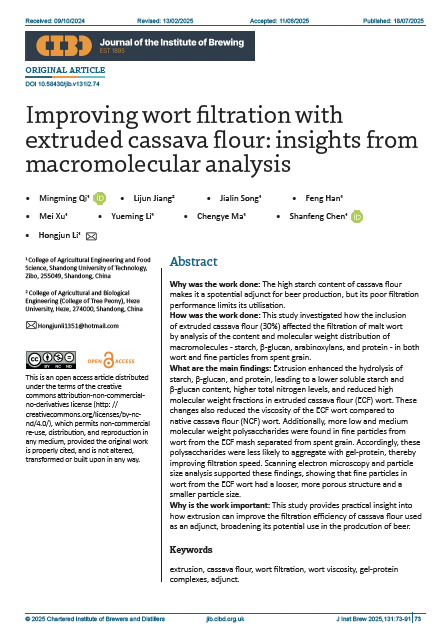
Why was the work done: The high starch content of cassava flour makes it a potential adjunct for beer production, but its poor filtration performance limits its utilisation.
How was the work done: This study investigated how the inclusion of extruded cassava flour (30%) affected the filtration of malt wort by analysis of the content and molecular weight distribution of macromolecules - starch, β-glucan, arabinoxylan, and protein - in both wort and fine particles from spent grain.
What are the main findings: Extrusion enhanced the hydrolysis of starch, β-glucan, and protein, leading to a lower soluble starch and β-glucan content, higher total nitrogen levels, and reduced high molecular weight fractions in extruded cassava flour (ECF) wort. These changes also reduced the viscosity of the ECF wort compared to native cassava flour (NCF) wort. Additionally, more low and medium molecular weight polysaccharides were found in fine particles from wort from the ECF mash separated from spent grain. Accordingly, these polysaccharides were less likely to aggregate with gel-protein, thereby improving filtration speed. Scanning electron microscopy and particle size analysis supported these findings, showing that fine particles in wort from the ECF wort had a looser, more porous structure and a smaller particle size.
Why is the work important: This study provides practical insight into how extrusion can improve the filtration efficiency of cassava flour used as an adjunct, broadening its potential use in the production of beer.
Downloads
References
Andersson R, Fransson G, Tietjen M, Åman P. 2009. Content and molecular-weight distribution of dietary fiber components in whole-grain rye flour and bread. J Agric Food Chem 57:2004-2008.
Bamforth CW. 2002. Nutritional aspects of beer—a review. Nutr Res 22:227-237.
Barrett J, Bathgate G, Clapperton J. 1975. The composition of fine particles which affect mash filtration. J Inst Brew 81:31-36.
Barrett J, Clapperton J, Divers D, Rennie H. 1973. Factors affecting wort separation. J Inst Brew 79:407-413.
Briggs D, Wadeson A, Statham R, Taylor J. 1986. The use of extruded barley, wheat and maize as adjuncts in mashing. J Inst Brew 92:468-474.
Buhler TM. 1996. Effects of physical parameters in mashing on lautering performance. PhD thesis, Loughborough University, UK.
Cadenas R, Caballero I, Nimubona D, Blanco CA. 2021. Brewing with starchy adjuncts: Its influence on the sensory and nutritional properties of beer. Foods 10:1726.
Celus I, Brijs K, Delcour JA. 2006. The effects of malting and mashing on barley protein extractability. J Cereal Sci 44:203-211.
Chisenga SM, Workneh TS, Bultosa G, Alimi BA. 2019. Progress in research and applications of cassava flour and starch: a review. J Food Sci Tech 562799-2813.
Connolly A, Piggott CO, FitzGerald RJ. 2013. Characterisation of protein‐rich isolates and antioxidative phenolic extracts from pale and black brewers' spent grain. Int J Food Sci Technol 48:1670-1681.
Dale C, Young T, Makinde A. 1989. Extruded sorghum as a brewing raw material. J Inst Brew 95:157-164.
Desobgo ZS, Nso EJ, Tenin D, Kayem G. 2010. Modelling and optimizing of mashing enzymes—effect on yield of filtrate of unmalted sorghum by use of response surface methodology. J Inst Brew 116:62-69.
Douglas S. 1981. A rapid method for the determination of pentosans in wheat flour. Food Chem 7:139-145.
Fadel A, Ashworth J, Plunkett A, Mahmoud AM, Ranneh Y, Li W. 2018. Improving the extractability of arabinoxylans and the molecular weight of wheat endosperm using extrusion processing. J Cereal Sci 8455-61.
Fumi MD, Galli R, Lambri M, Donadini G, De Faveri DM. 2009. Impact of full-scale brewing processes on lager beer nitrogen compounds. Eur Food Res Technol 230209-216.
Goode DL, Halbert C, Arendt EK. 2002. Mashing studies with unmalted sorghum and malted barley. J Inst Brew 108:465-473.
Grujić O. 1999. Application of unconventional raw materials and procedures in wort production. J Inst Brew 105:275-278.
Gruppen H, Hamer R, Voragen A. 1991. Barium hydroxide as a tool to extract pure arabinoxylans from water-insoluble cell wall material of wheat flour. J Cereal Sci 13:275-290.
Hao J, Li Q, Dong J, Yu J, Gu G, Fan W, Chen J. 2006. Identification of the major proteins in beer foam by mass spectrometry following sodium dodecyl sulfate-polyacrylamide gel electrophoresis. J Am Soc Brew Chem 64:166-174.
Hennemann M, Gastl M, Becker T. 2019. Inhomogeneity in the lauter tun: A chromatographic view. Eur Food Res Technol 245521-533.
Home S, Pietilä K, Sjoholm K. 1993. Control of glucanolysis in mashing. J Am Soc Brew Chem 51:108-113.
Hug H, Pfenninger H. 1980. Cassava as raw material for beer production. Brau-Rundsch 91:149-153.
Huston Jr CK, Oh S-S, Lewis M. 1986. The protein character of beer is defined in the brewhouse. J Am Soc Brew Chem 44:40-44.
Jiang L, Song J, Qi M, Suo W, Deng Y, Liu Y, Li L, Zhang D, Wang C, Li H. 2023. Modification mechanism of protein in rice adjuncts upon extrusion and its effects on nitrogen conversion during mashing. Food Chem 407135150.
Jin Y-L, Speers RA, Paulson AT, Stewart RJ. 2004. Barley beta-glucans and their degradation during malting and brewing. Tech Q Master. Brew Assoc Am 41:231-240.
Jin Y-L, Speers RA, Paulson AT, Stewart RJ. 2004. Effects of β-glucans, shearing, and environmental factors on wort filtration performance. J Am Soc Brew Chem 62:155-162.
Kupetz M, Procopio S, Sacher B, Becker T. 2015. Critical review of the methods of β-glucan analysis and its significance in the beer filtration process. Eur Food Res Technol 241725-736.
Li C, Dong G, Bian M, Liu X, Gong J, Hao J, Wang W, Li K, Ou W, Xia T. 2021. Brewing rich 2‐ phenylethanol beer from cassava and its producing metabolisms in yeast. J Sci Food Agric 101:4050-4058.
Li M, Hasjim J, Xie F, Halley PJ, Gilbert RG. 2014. Shear degradation of molecular, crystalline, and granular structures of starch during extrusion. Starch‐Stärke 66:595-605.
Li Y, Lu J, Gu G. 2005. Control of arabinoxylan solubilization and hydrolysis in mashing. Food Chem 90:101-108.
Li Y, Maurice M-JS. 2013. Development of a fast and reliable microwave-based assay for measurement of malt color. J Am Soc Brew Chem 71:144-148.
Lu J, Li Y. 2006. Effects of arabinoxylan solubilization on wort viscosity and filtration when mashing with grist containing wheat and wheat malt. Food Chem 98:164-170.
Ma C, He Y, Cao Y, Bai X, Li H. 2016. Analysis of flavour compounds in beer with extruded sorghum as an adjunct using headspace solid‐phase micro‐extraction and gas chromatography–mass spectrometry. J Inst Brew 122:251-260.
Marconi O, Tomasi I, Dionisio L, Perretti G, Fantozzi P. 2014. Effects of malting on molecular weight distribution and content of water-extractable β-glucans in barley. Food Res Int 64677-682.
Muller R. 1995. Factors influencing the stability of barley malt β-glucanase during mashing. J Am Soc Brew Chem 53:136-140.
Niu C, Han Y, Wang J, Zheng F, Liu C, Li Y, Li Q. 2018. Malt derived proteins: Effect of protein Z on beer foam stability. Food Biosci 2521-27.
Park J, Sung JM, Choi Y-S, Park J-D. 2021. pH-dependent pasting and texture properties of rice flour subjected to limited protein hydrolysis. Food Hydrocoll 117106754.
Poreda A, Czarnik A, Zdaniewicz M, Jakubowski M, Antkiewicz P. 2014. Corn grist adjunct–application and influence on the brewing process and beer quality. J Inst Brew 120:77-81.
Qi M, Jiang L, Song J, Suo W, Deng Y, Li L, Liu Y, Wang C, Li H. 2023. Extrusion modification of cassava flour for improved mashing efficiency. LWT-Food Sci Technol 177114565.
Sadosky P, Schwarz PB, Horsley RD. 2002. Effect of arabinoxylans, β-glucans, and dextrins on the viscosity and membrane filterability of a beer model solution. J Am Soc Brew Chem 60:153-162.
Sadosky PT. 2008. Effects of malting and mashing conditions on the molecular weights of arabinoxylan and β-glucan in wort. PhD thesis, North Dakota State University.
Saengchan K, Nopharatana M, Lerdlattaporn R, Songkasiri W. 2015. Enhancement of starch-pulp separation in centrifugal-filtration process: Effects of particle size and variety of cassava root on free starch granule separation. Food Bioprod Process 95208-217.
Sharma P, Gujral HS. 2013. Extrusion of hulled barley affecting β-glucan and properties of extrudates. Food Bioproc Tech 61374-1389.
Silva F, Nogueira LC, Gonçalves C, Ferreira AA, Ferreira IM, Teixeira N. 2008. Electrophoretic and HPLC methods for comparative study of the protein fractions of malts, worts and beers produced from Scarlett and Prestige barley (Hordeum vulgare L.) varieties. Food Chem 106:820-829. 7.
Tomasi I, Marconi O, Sileoni V, Perretti G. 2017. Validation of a high-performance size-exclusion chromatography method to determine and characterize β-glucans in beer wort using a triple-detector array. Food Chem 214176-182.
Viëtor R, Voragen A, Angelino S. 1993. Composition of non‐starch polysaccharides in wort and spent grain from brewing trials with malt from a good malting quality barley and a feed barley. J Inst Brew 99:243-248.
Vriesekoop F, Rathband A, MacKinlay J, Bryce JH. 2010. The evolution of dextrins during the mashing and fermentation of all‐malt whisky production. J Inst Brew 116:230-238.
Wang B, Dong Y, Fang Y, Gao W, Kang X, Liu P, Yan S, Cui B, Abd El-Aty A. 2022. Effects of different moisture contents on the structure and properties of corn starch during extrusion. Food Chem 368130804.
Xie L, Jin Y, Du J, Zhang K. 2014. Water‐soluble protein molecular weight distribution and effects on wheat malt quality during malting. J Inst Brew 120:399-403.
Ye J, Hu X, Luo S, Liu W, Chen J, Zeng Z, Liu C. 2018. Properties of starch after extrusion: A review. Starch‐Stärke 70:1700110.
Yu W, Gilbert RG, Fox GP. 2020. Malt protein inhibition of β-amylase alters starch molecular structure during barley mashing. Food Hydrocoll 100105423.
Yu W, Tan X, Zou W, Hu Z, Fox GP, Gidley MJ, Gilbert RG. 2017. Relationships between protein content, starch molecular structure and grain size in barley. Carbohydr Polym 155271-279.
Zhang B, Liu G, Ying D, Sanguansri L, Augustin MA. 2017. Effect of extrusion conditions on the physico-chemical properties and in vitro protein digestibility of canola meal. Food Res Int 100658-664.
Zhu L, Ma T, Li Y, Li Q. 2015. Permeability analysis of high-adjunct-ratio spent grain layer in the high-gravity wort separation process. Process Biochem 50:846-852.
Downloads
Published
Versions
- 19-07-2025 (2)
- 18-07-2025 (1)
How to Cite
Issue
Section
License
Copyright (c) 2025 Journal of the Institute of Brewing

This work is licensed under a Creative Commons Attribution-NonCommercial-NoDerivatives 4.0 International License.
This is an open access article which permits non-commercial re-use, distribution, and reproduction in any medium, provided the original work is properly cited, and is not altered, transformed or built upon in any way.
Permission will be required if the proposed reuse is not covered by the terms of the License. In this event, email the Editor in Chief - david.quain@cibd.org.uk - with details of your request.